


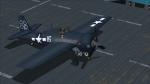
6.26Mb (57 downloads)
General Motors FM-2 Wildcat VC-93 on USS Petrof Bay (CVE-80) off Okinawa April 1945.
In 1942, automobile manufacturer General Motors converted several of its east coast factories to aircraft production under the name Eastern Aircraft Division. Eastern received contracts to build F4F-4 Wildcat fighters and TBF-1 'Avenger' torpedo planes, allowing Grumman to gradually reconcentrate its energies on the new, urgently-needed F6F 'Hellcat' fighter. The GM F4F-4s, redesignated FM-1s, had only four .50 caliber machine guns, but were otherwise little changed from the original model. Well over a thousand FM-1 fighters were delivered in 1942-43, including some three hundred for the British Royal Navy.
Meanwhile, Grumman had prototyped a new Wildcat under the designation XF4F-8, which was to be produced by Eastern Aircraft as the FM-2. With lightened structure and a more powerful Wright R-1820 radial engine, the FM-2 was notably quicker, faster climbing, longer ranged and more maneuverable than its predecessor. To help control the increased power, the new plane had a distinctive, taller vertical tail. All-in-all, it was a great improvement, and more than four thousand FM-2s were built in 1943-45. Of those, over three hundred went to the British.
Credits
Captain Kurt: Aircraft model, drop tanks, bomb racks, rockets, VC, paint textures, aircraft flight files, and .dp
Shessi: Pilot figure
Morton: 2D F4F instrument panel modified to an FM-2 version
Kelticheart: Prop blurred texture
Microsoft: Gauges and .air file
AliCat: Oxygen meter gauge
Posted Feb 22, 2026 18:41 by Captain Kurt
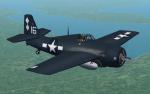
6.05Mb (41 downloads)
General Motors FM-2 Wildcat VC-79 on USS Sargent Bay (CVE-83) off Okinawa April 1945.
In 1942, automobile manufacturer General Motors converted several of its east coast factories to aircraft production under the name Eastern Aircraft Division. Eastern received contracts to build F4F-4 Wildcat fighters and TBF-1 'Avenger' torpedo planes, allowing Grumman to gradually reconcentrate its energies on the new, urgently-needed F6F 'Hellcat' fighter. The GM F4F-4s, redesignated FM-1s, had only four .50 caliber machine guns, but were otherwise little changed from the original model. Well over a thousand FM-1 fighters were delivered in 1942-43, including some three hundred for the British Royal Navy.
Meanwhile, Grumman had prototyped a new Wildcat under the designation XF4F-8, which was to be produced by Eastern Aircraft as the FM-2. With lightened structure and a more powerful Wright R-1820 radial engine, the FM-2 was notably quicker, faster climbing, longer ranged and more maneuverable than its predecessor. To help control the increased power, the new plane had a distinctive, taller vertical tail. All-in-all, it was a great improvement, and more than four thousand FM-2s were built in 1943-45. Of those, over three hundred went to the British.
Credits
Captain Kurt: Aircraft model, drop tanks, bomb racks, rockets, VC, paint textures, aircraft flight files, and .dp
Shessi: Pilot figure
Morton: 2D F4F instrument panel modified to an FM-2 version
Kelticheart: Prop blurred texture
Microsoft: Gauges and .air file
AliCat: Oxygen meter gauge
Posted Feb 22, 2026 18:38 by Captain Kurt
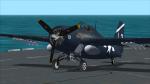
6.16Mb (19 downloads)
General Motors FM-2 Wildcat VC-82 on USS Anzio (CVE-57) off Okinawa April 1945. In 1942, automobile manufacturer General Motors converted several of its east coast factories to aircraft production under the name Eastern Aircraft Division. Eastern received contracts to build F4F-4 Wildcat fighters and TBF-1 'Avenger' torpedo planes, allowing Grumman to gradually reconcentrate its energies on the new, urgently-needed F6F 'Hellcat' fighter. The GM F4F-4s, redesignated FM-1s, had only four .50 caliber machine guns, but were otherwise little changed from the original model. Well over a thousand FM-1 fighters were delivered in 1942-43, including some three hundred for the British Royal Navy.
Meanwhile, Grumman had prototyped a new Wildcat under the designation XF4F-8, which was to be produced by Eastern Aircraft as the FM-2. With lightened structure and a more powerful Wright R-1820 radial engine, the FM-2 was notably quicker, faster climbing, longer ranged and more maneuverable than its predecessor. To help control the increased power, the new plane had a distinctive, taller vertical tail. All-in-all, it was a great improvement, and more than four thousand FM-2s were built in 1943-45. Of those, over three hundred went to the British.
Credits
Captain Kurt: Aircraft model, drop tanks, bomb racks, rockets, VC, paint textures, aircraft flight files, and .dp
Shessi: Pilot figure
Morton: 2D F4F instrument panel modified to an FM-2 version
Kelticheart: Prop blurred texture
Microsoft: Gauges and .air file
AliCat: Oxygen meter gauge
Posted Feb 22, 2026 18:37 by Captain Kurt
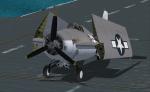
5.85Mb (23 downloads)
General Motors FM-2 Wildcat VC-36 on USS Core (CVE-66) in the Atlantic, 1944. This composite squadron was credited with sinking 6 German U-boats.
In 1942, automobile manufacturer General Motors converted several of its east coast factories to aircraft production under the name Eastern Aircraft Division. Eastern received contracts to build F4F-4 Wildcat fighters and TBF-1 'Avenger' torpedo planes, allowing Grumman to gradually reconcentrate its energies on the new, urgently-needed F6F 'Hellcat' fighter. The GM F4F-4s, redesignated FM-1s, had only four .50 caliber machine guns, but were otherwise little changed from the original model. Well over a thousand FM-1 fighters were delivered in 1942-43, including some three hundred for the British Royal Navy.
Meanwhile, Grumman had prototyped a new Wildcat under the designation XF4F-8, which was to be produced by Eastern Aircraft as the FM-2. With lightened structure and a more powerful Wright R-1820 radial engine, the FM-2 was notably quicker, faster climbing, longer ranged and more maneuverable than its predecessor. To help control the increased power, the new plane had a distinctive, taller vertical tail. All-in-all, it was a great improvement, and more than four thousand FM-2s were built in 1943-45. Of those, over three hundred went to the British.
Credits
Captain Kurt: Aircraft model, drop tanks, bomb racks, rockets, VC, paint textures, aircraft flight files, and .dp
Shessi: Pilot figure
Morton: 2D F4F instrument panel modified to an FM-2 version
Kelticheart: Prop blurred texture
Microsoft: Gauges and .air file
AliCat: Oxygen meter gauge
Posted Feb 22, 2026 18:08 by Captain Kurt
6.84Mb (21 downloads)
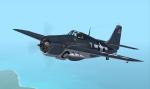
General Motors FM-2 Wildcat VC-4 on USS White Plains (CVE-66) 1944
In 1942, automobile manufacturer General Motors converted several of its east coast factories to aircraft production under the name Eastern Aircraft Division. Eastern received contracts to build F4F-4 Wildcat fighters and TBF-1 'Avenger' torpedo planes, allowing Grumman to gradually reconcentrate its energies on the new, urgently-needed F6F 'Hellcat' fighter. The GM F4F-4s, redesignated FM-1s, had only four .50 caliber machine guns, but were otherwise little changed from the original model. Well over a thousand FM-1 fighters were delivered in 1942-43, including some three hundred for the British Royal Navy.
Meanwhile, Grumman had prototyped a new Wildcat under the designation XF4F-8, which was to be produced by Eastern Aircraft as the FM-2. With lightened structure and a more powerful Wright R-1820 radial engine, the FM-2 was notably quicker, faster climbing, longer ranged and more maneuverable than its predecessor. To help control the increased power, the new plane had a distinctive, taller vertical tail. All-in-all, it was a great improvement, and more than four thousand FM-2s were built in 1943-45. Of those, over three hundred went to the British.
Credits
Captain Kurt: Aircraft model, drop tanks, bomb racks, rockets, VC, paint textures, aircraft flight files, and .dp
Shessi: Pilot figure
Morton: 2D F4F instrument panel modified to an FM-2 version
Kelticheart: Prop blurred texture
Microsoft: Gauges and .air file
AliCat: Oxygen meter gauge
Posted Feb 22, 2026 18:07 by Captain Kurt
5.10Mb (43 downloads)
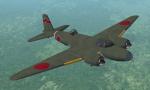
Mitsubishi Ki-21 IIb
Further revisions of defensive armament were made, the Ki-21-IIb replacing the dorsal gun position by a manually operated gun turret containing one 12.7 mm (0.50 in) machine-gun. The Ki-21-IIb was used during the series of Japanese bombing raids on Calcutta in December 1943, where it suffered heavy losses. During the Lae campaign, the IJAAF experimented with the use of the Ki-21 as a PT boat hunter, in an attempt to protect their barge traffic from Rabaul to New Guinea, which proved unsuccessful. With better equiped Allied aircraft, the Ki-21 suffered increasingly heavy losses and due to the lack of a suitable replacement meant that the Ki-21 remained in front line service in large numbers until well into 1944. With the arrival of the Mitsubishi Ki-67 'Hiryu', the Ki-21 was quickly withdrawn from front line operations, as the Ki-67 was a better replacement aircraft. Towards the end of the war, remaining Ki-21s were used by Giretsu Special Forces in strikes against American forces in Okinawa and the Ryukyu Islands. One of the noted operations was an attack on the Allied-held Yontan airfield and Kadena airfield on the night of 24 May 1945. In spite of its shortcomings, the Ki-21 remained in service until the end of the war, being utilized as transport (along with the civil transport version MC-21), bomber crew and paratrooper trainer, for liaison and communications, special commando and secret missions, and kamikaze operations.
Production of the Ki-21 ended in September 1944.
Credits
Captain Kurt: Aircraft model, VC, paint textures, aircraft flight files, and .dp
Wolfi: Crew figures and special thanks for guidance on what the cockpit looked like, based on his Ki-57 Topsy model.
Allen: Japanese bombs (included in zip file)
Gauges by: Robert L. Clark, FDG2 and Microsoft
Posted Feb 16, 2026 16:39 by Captain Kurt
5.60Mb (44 downloads)
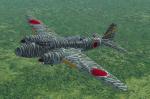
Mitsubishi Ki-21 IIa Sally (or "Type 97 Heavy Bomber")
The IJAAF never had any true heavy bombers, but one medium type was common, the Ki-21 ‘Sally’. The Japanese classed what other air forces would call a medium bomber, as a heavy bomber. Japanese Imperial Army Air Force front line units from mid-1940 were equipped with the Mitsubishi Ki-21-IIa variant with the more powerful 1,118 kW (1,500 hp) Mitsubishi Ha-101 air-cooled engines and larger horizontal tail surfaces, which was a development of the earlier Ki-21-I deployed in 1938. This became the main version operated by most IJAAF heavy bomber squadrons at the beginning of the Pacific War, and played a major role in many early campaigns. On 8 December 1941, the 5th, 14th and 62nd Sentai, based in Taiwan began operations over the Philippines attacking American targets at Aparri, Tuguegarao, Vigan and other targets in Luzon. On 20 December the Ki-21s of the 12th, 60th, 62nd and 98th Sentai clashed with P-40s of the American Volunteer Group over Kumming, while on 23 December they faced a mix of RAF F2A 'Buffaloes' from No.67 Squadron and aircraft from the A.V.G. during raids on Rangoon and Mingaladon where twenty Ki-21s were shot down at a cost of two Allied pilots. The 3rd, 12th, 60th and 98th Sentai, based in French Indochina, struck British and Australian targets in Thailand and Malaya, bombing Alor Star, Sungai Petani and Butterworth, under escort by Nakajima Ki-27 and Ki-43 fighters. However, starting with the operations over Burma in December 1941 and early 1942, the Ki-21 began to suffer heavy casualties from the A.V.G. Curtiss P-40s and RAF Hawker Hurricanes. Some of the Ki-21-IIa version were still on front line use as late as 1943.
Credits
Captain Kurt: Aircraft model, VC, paint textures, aircraft flight files, and .dp
Wolfi: Crew figures and special thanks for guidance on what the cockpit looked like, based on his Ki-57 Topsy model.
Allen: Japanese bombs (included in zip file)
Gauges by: Robert L. Clark, FDG2 and Microsoft
Posted Feb 16, 2026 16:36 by Captain Kurt
9.49Mb (47 downloads)
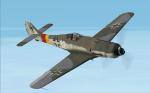
Focke Wulf Fw 190D-9
by Design Team Daedalus
Unit: 5./JG301 Bad Langensalza, May 1945
Pilot: unknown
The Fw 190D-9 combined the Fw 190A-8 fuselage and wings with the Jumo 213A-1 engine to create a higher altitude capable fighter than the A-8. The first production aircraft were completed at Focke-Wulf’s factory at Sorau in Silesia in late August 1944. Problems with engine meant that the second aircraft wasn’t completed until mid-September, but construction soon sped up. By the end of September production was underway at Focke-Wulf’s factory at Cottbus, and in October work began at Roland (WFG) at Nordenahm and Fieseler at Kassel. Junkers and Siebel produced parts, and Arado was also involved in the program. The total number produced is unclear, with at least 670 known and no records for December 1944 or February 1945 to the end of the war. 1,500 serial numbers are known to have been allocated to the D-9, but that doesn’t mean that all of these aircraft were completed.
The standard D-9 was armed with two 13mm MG 131 machine guns above the engine and two 20mm MG 151 cannon in the wing roots. It could also carry an ETC 501 or ETC 504 stores carriers below the fuselage.
The first D-9 unit, III./JG 54, began to convert to the type in September 1944, and by the end of October had 68 aircraft, of which only one had the MW 50 installed. However 53 had been given a new Junkers kit that increased the manifold pressure in the engine and boosted power from 1,750hp to around 1,870hp.
By the end of December 1944 there were 183 D-9s in service with three units (III./JG 54, II./JG 26 and III./JG 26), with some equipped with both the MW 50 and Junkers kits, some with one or the other and some without either. However new aircraft coming off the production line mainly had both.
Early in 1945 the D-9 was issued to JG 2, JG 3, JG 6, JG 51 and JG 301, although these units normally operated a mix of types. In service the D-9 was considered to be as good as its main opponents, in particular the Merlin powered P-51 Mustangs and the Griffon powered Spitfire Mk.XIV. It handled better than the Fw 190A, was faster and climbed quicker. It could out-turn most Soviet fighters at the normal combat levels, and was quicker in the dive than the Yak-3 or Yak-9.
It was a very good fighter for that time but was too little too late to have any effect on the course of the war.
--------------------------------------------------------------------------------------------------------------------------------------------------------------------
Captain Kurt developed the model from the old Pstrany Dora model - with permission - as a starting framework and updated the shape, and added multiple details, new parts, new VC, and animations. The original Pstrany airfiles, and Dora weapons models for the drop tanks, weapons, and racks are still used as is the Jumo sound package (included)
Captain Kurt also created the camouflage paint, and the 2D instrument panel.
Posted Feb 7, 2026 22:56 by Design Team Daedalus
10.81Mb (43 downloads)
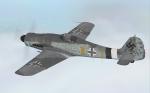
Focke Wulf Fw 190D-9
by Design Team Daedalus
Unit: 9./JG26 Celle, Germany, March, 1945
Pilot: unknown
The Fw 190D-9 combined the Fw 190A-8 fuselage and wings with the Jumo 213A-1 engine to create a higher altitude capable fighter than the A-8. The first production aircraft were completed at Focke-Wulf’s factory at Sorau in Silesia in late August 1944. Problems with engine meant that the second aircraft wasn’t completed until mid-September, but construction soon sped up. By the end of September production was underway at Focke-Wulf’s factory at Cottbus, and in October work began at Roland (WFG) at Nordenahm and Fieseler at Kassel. Junkers and Siebel produced parts, and Arado was also involved in the program. The total number produced is unclear, with at least 670 known and no records for December 1944 or February 1945 to the end of the war. 1,500 serial numbers are known to have been allocated to the D-9, but that doesn’t mean that all of these aircraft were completed.
The standard D-9 was armed with two 13mm MG 131 machine guns above the engine and two 20mm MG 151 cannon in the wing roots. It could also carry an ETC 501 or ETC 504 stores carriers below the fuselage.
The first D-9 unit, III./JG 54, began to convert to the type in September 1944, and by the end of October had 68 aircraft, of which only one had the MW 50 installed. However 53 had been given a new Junkers kit that increased the manifold pressure in the engine and boosted power from 1,750hp to around 1,870hp.
By the end of December 1944 there were 183 D-9s in service with three units (III./JG 54, II./JG 26 and III./JG 26), with some equipped with both the MW 50 and Junkers kits, some with one or the other and some without either. However new aircraft coming off the production line mainly had both.
Early in 1945 the D-9 was issued to JG 2, JG 3, JG 6, JG 51 and JG 301, although these units normally operated a mix of types. In service the D-9 was considered to be as good as its main opponents, in particular the Merlin powered P-51 Mustangs and the Griffon powered Spitfire Mk.XIV. It handled better than the Fw 190A, was faster and climbed quicker. It could out-turn most Soviet fighters at the normal combat levels, and was quicker in the dive than the Yak-3 or Yak-9.
It was a very good fighter for that time but was too little too late to have any effect on the course of the war.
--------------------------------------------------------------------------------------------------------------------------------------------------------------------
Captain Kurt developed the model from the old Pstrany Dora model - with permission - as a starting framework and updated the shape, and added multiple details, new parts, new VC, and animations. The original Pstrany airfiles, and Dora weapons models for the drop tanks, weapons, and racks are still used as is the Jumo sound package (included)
Captain Kurt also created the camouflage paint, and the 2D instrument panel.
Posted Feb 7, 2026 22:54 by Design Team Daedalus
18.01Mb (39 downloads)
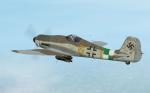
Focke Wulf Fw 190D-9 Ta 152 tail
by Design Team Daedalus
Unit: 9./JG(J)27
Pilot: unknown
The Fw 190D-9 combined the Fw 190A-8 fuselage and wings with the Jumo 213A-1 engine to create a higher altitude capable fighter than the A-8. The first production aircraft were completed at Focke-Wulf’s factory at Sorau in Silesia in late August 1944. Problems with engine meant that the second aircraft wasn’t completed until mid-September, but construction soon sped up. By the end of September production was underway at Focke-Wulf’s factory at Cottbus, and in October work began at Roland (WFG) at Nordenahm and Fieseler at Kassel. Junkers and Siebel produced parts, and Arado was also involved in the program. The total number produced is unclear, with at least 670 known and no records for December 1944 or February 1945 to the end of the war. 1,500 serial numbers are known to have been allocated to the D-9, but that doesn’t mean that all of these aircraft were completed.
A few Ta 152 tail surfaces found their way to some Doras apparently through a lack of standard units. These were assembled by subcontractors, and delivered near final assembly. It is very likely it was due to problems in logistics control.
The standard D-9 was armed with two 13mm MG 131 machine guns above the engine and two 20mm MG 151 cannon in the wing roots. It could also carry an ETC 501 or ETC 504 stores carriers below the fuselage.
The first D-9 unit, III./JG 54, began to convert to the type in September 1944, and by the end of October had 68 aircraft, of which only one had the MW 50 installed. However 53 had been given a new Junkers kit that increased the manifold pressure in the engine and boosted power from 1,750hp to around 1,870hp.
By the end of December 1944 there were 183 D-9s in service with three units (III./JG 54, II./JG 26 and III./JG 26), with some equipped with both the MW 50 and Junkers kits, some with one or the other and some without either. However new aircraft coming off the production line mainly had both.
Early in 1945 the D-9 was issued to JG 2, JG 3, JG 6, JG 51 and JG 301, although these units normally operated a mix of types. In service the D-9 was considered to be as good as its main opponents, in particular the Merlin powered P-51 Mustangs and the Griffon powered Spitfire Mk.XIV. It handled better than the Fw 190A, was faster and climbed quicker. It could out-turn most Soviet fighters at the normal combat levels, and was quicker in the dive than the Yak-3 or Yak-9.
It was a very good fighter for that time but was too little too late to have any effect on the course of the war.
--------------------------------------------------------------------------------------------------------------------------------------------------------------------
Captain Kurt developed the model from the old Pstrany Dora model - with permission - as a starting framework and updated the shape, and added multiple details, new parts, new VC, and animations. The original Pstrany airfiles, and Dora weapons models for the drop tanks, weapons, and racks are still used as is the Jumo sound package (included)
Captain Kurt also created the camouflage paint, and the 2D instrument panel.
Posted Feb 7, 2026 22:52 by Design Team Daedalus