


CFS2 > Page 5
10.13Mb (36 downloads)
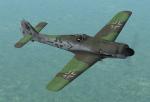
Focke Wulf Fw 190D-9 early canopy
by Design Team Daedalus
Unit: Stab II./JG 6 Airbase Ruzyne, Prague, Czechoslovakia May, 1945
Pilot: unknown
The Fw 190D-9 combined the Fw 190A-8 fuselage and wings with the Jumo 213A-1 engine to create a higher altitude capable fighter than the A-8. The first production aircraft were completed at Focke-Wulf’s factory at Sorau in Silesia in late August 1944. Problems with engine meant that the second aircraft wasn’t completed until mid-September, but construction soon sped up. By the end of September production was underway at Focke-Wulf’s factory at Cottbus, and in October work began at Roland (WFG) at Nordenahm and Fieseler at Kassel. Junkers and Siebel produced parts, and Arado was also involved in the program. The total number produced is unclear, with at least 670 known and no records for December 1944 or February 1945 to the end of the war. 1,500 serial numbers are known to have been allocated to the D-9, but that doesn’t mean that all of these aircraft were completed.
The standard D-9 was armed with two 13mm MG 131 machine guns above the engine and two 20mm MG 151 cannon in the wing roots. It could also carry an ETC 501 or ETC 504 stores carriers below the fuselage.
TThe first D-9 unit, III./JG 54, began to convert to the type in September 1944, and by the end of October had 68 aircraft, of which only one had the MW 50 installed. However 53 had been given a new Junkers kit that increased the manifold pressure in the engine and boosted power from 1,750hp to around 1,870hp.
By the end of December 1944 there were 183 D-9s in service with three units (III./JG 54, II./JG 26 and III./JG 26), with some equipped with both the MW 50 and Junkers kits, some with one or the other and some without either. However new aircraft coming off the production line mainly had both.
Early in 1945 the D-9 was issued to JG 2, JG 3, JG 6, JG 51 and JG 301, although these units normally operated a mix of types. In service the D-9 was considered to be as good as its main opponents, in particular the Merlin powered P-51 Mustangs and the Griffon powered Spitfire Mk.XIV. It handled better than the Fw 190A, was faster and climbed quicker. It could out-turn most Soviet fighters at the normal combat levels, and was quicker in the dive than the Yak-3 or Yak-9.
It was a very good fighter for that time but was too little too late to have any effect on the course of the war.
--------------------------------------------------------------------------------------------------------------------------------------------------------------------
Captain Kurt developed the model from the old Pstrany Dora model - with permission - as a starting framework and updated the shape, and added multiple details, new parts, new VC, and animations. The original Pstrany airfiles, and Dora weapons models for the drop tanks, weapons, and racks are still used as is the Jumo sound package (included)
Model revision 3 fixes an animation error and several minor model improvements
Captain Kurt also created the camouflage paint, and the 2D instrument panel.
Posted Jan 17, 2026 15:39 by Design Team Daedalus
10.49Mb (38 downloads)
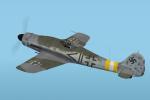
Focke Wulf Fw 190D-9 early canopy
by Design Team Daedalus
Unit: Stab I./JG 2 Bodenplatte operation, Dorff, Germany January 1, 1945
Pilot: Fw. Werner Hohenburg
The Fw 190D-9 combined the Fw 190A-8 fuselage and wings with the Jumo 213A-1 engine to create a higher altitude capable fighter than the A-8. The first production aircraft were completed at Focke-Wulf’s factory at Sorau in Silesia in late August 1944. Problems with engine meant that the second aircraft wasn’t completed until mid-September, but construction soon sped up. By the end of September production was underway at Focke-Wulf’s factory at Cottbus, and in October work began at Roland (WFG) at Nordenahm and Fieseler at Kassel. Junkers and Siebel produced parts, and Arado was also involved in the program. The total number produced is unclear, with at least 670 known and no records for December 1944 or February 1945 to the end of the war. 1,500 serial numbers are known to have been allocated to the D-9, but that doesn’t mean that all of these aircraft were completed.
The standard D-9 was armed with two 13mm MG 131 machine guns above the engine and two 20mm MG 151 cannon in the wing roots. It could also carry an ETC 501 or ETC 504 stores carriers below the fuselage.
The first D-9 unit, III./JG 54, began to convert to the type in September 1944, and by the end of October had 68 aircraft, of which only one had the MW 50 installed. However 53 had been given a new Junkers kit that increased the manifold pressure in the engine and boosted power from 1,750hp to around 1,870hp.
By the end of December 1944 there were 183 D-9s in service with three units (III./JG 54, II./JG 26 and III./JG 26), with some equipped with both the MW 50 and Junkers kits, some with one or the other and some without either. However new aircraft coming off the production line mainly had both.
Early in 1945 the D-9 was issued to JG 2, JG 3, JG 6, JG 51 and JG 301, although these units normally operated a mix of types. In service the D-9 was considered to be as good as its main opponents, in particular the Merlin powered P-51 Mustangs and the Griffon powered Spitfire Mk.XIV. It handled better than the Fw 190A, was faster and climbed quicker. It could out-turn most Soviet fighters at the normal combat levels, and was quicker in the dive than the Yak-3 or Yak-9.
It was a very good fighter for that time but was too little too late to have any effect on the course of the war.
--------------------------------------------------------------------------------------------------------------------------------------------------------------------
Captain Kurt developed the model from the old Pstrany Dora model - with permission - as a starting framework and updated the shape, and added multiple details, new parts, new VC, and animations. The original Pstrany airfiles, and Dora weapons models for the drop tanks, weapons, and racks are still used as is the Jumo sound package (included)
Model revision 3 fixes an animation error and several minor model improvements
Captain Kurt also created the camouflage paint, and the 2D instrument panel.
Posted Jan 17, 2026 09:44 by Design Team Daedalus
5.06Mb (64 downloads)
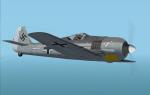
Focke Wulf Fw 190A-3
Unit: 4./JG1, Woensdrecht, the Netherlands March 1942
Pilot: Oblt. Robert Olejnik
This aircraft had all 4 wing cannons.
The Fw 190 series entered combat with the A-1 model in September 1941 proving a huge shock to the RAF as it was clearly superior to the Spitfire V (which was the primary RAF fighter at the time) in everything except turning radius. However these early versions suffered from severe engine overheating problems and fires which kept serviceability rates low throughout 1941. This was somewhat solved in the field by JG26 technical officers by rerouting the exhaust pipes and opening cooling slots in the fuselage aft of the engine. These changes were introduced into the production line for the following A-2 models which began arriving in December 1941.
The Fw 190 A-3 began deliveries in the spring of 1942 with the change to the more powerful BMW 801D-2 1700hp engine using 96 octane fuel, replacing the unreliable BMW 801C-1 in the Fw190 A-2. Fw 190A-3 was externally identical to the A-2, which makes the two variants extremely difficult to tell apart. The only positive visual clues could only be seen up-close: the C3 fuel triangles and the Werknummer. Like the A-2, it had two cowl mounted MG 17 machine guns, two inboard wing mounted MG 151 20mm cannons with protruding barrels and wing root blisters, plus two MG FF 20mm cannons in outboard positions, with underwing bulges. The slower firing MG FF cannons with its limited 90 rpg were often removed in the field and panel bulges replaced with flat panels.
Besides the difference in the number of wing cannons, the only other major variant was the FW 190A-3/U3 fighter bomber which had an under-fuselage mounted bomb rack ETC 501 for carriage of 500 kg of bombs (1 500 kg, 1 250 kg or 4 50 kg on the ER4 adapter) or an external drop tank of 300 liter capacity for long range fighters. These usually had the retractable small gear cover doors removed which would interfere with the ordinance loads.
By early 1943, 509 A-3s had been built. By mid 1943 it was being relagated to opertional training organizations.
--------------------------------------------------------------------------------------------------------------------------------------------------------------------
Captain Kurt developed the model using some parts of the Design Team Daedalus Fw 190D-9 model, which in turn was developed from the old Pstrany Dora model by Captain Kurt - with permission. The new model added multiple details, new parts, new VC, and animations. The air files are a further development of the Design Team Daedalus FW 190 series.
Captain Kurt also created the camouflage paints, and the 2D instrument panel.
Keticheart: prop blur .bmp
AliCat: o2 Wachter and Sauerstoff guages
FSD: most of the gauges
other gauge authors are unknown
Posted Jan 12, 2026 16:22 by Captain Kurt
3.46Mb (50 downloads)
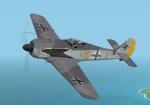
Focke Wulf Fw 190A-3
Unit: 9./JG2, Poix, France in the fall of 1942
Pilots: Ofw. Fritz Hartmann and Ltn. Heribert Hufnagl
This aircraft had the outer two wing cannons removed.
The Fw 190 series entered combat with the A-1 model in September 1941 proving a huge shock to the RAF as it was clearly superior to the Spitfire V (which was the primary RAF fighter at the time) in everything except turning radius. However these early versions suffered from severe engine overheating problems and fires which kept serviceability rates low throughout 1941. This was somewhat solved in the field by JG26 technical officers by rerouting the exhaust pipes and opening cooling slots in the fuselage aft of the engine. These changes were introduced into the production line for the following A-2 models which began arriving in December 1941.
The Fw 190 A-3 began deliveries in the spring of 1942 with the change to the more powerful BMW 801D-2 1700hp engine using 96 octane fuel, replacing the unreliable BMW 801C-1 in the Fw190 A-2. Fw 190A-3 was externally identical to the A-2, which makes the two variants extremely difficult to tell apart. The only positive visual clues could only be seen up-close: the C3 fuel triangles and the Werknummer. Like the A-2, it had two cowl mounted MG 17 machine guns, two inboard wing mounted MG 151 20mm cannons with protruding barrels and wing root blisters, plus two MG FF 20mm cannons in outboard positions, with underwing bulges. The slower firing MG FF cannons with its limited 90 rpg were often removed in the field and panel bulges replaced with flat panels.
Besides the difference in the number of wing cannons, the only other major variant was the FW 190A-3/U3 fighter bomber which had an under-fuselage mounted bomb rack ETC 501 for carriage of 500 kg of bombs (1 500 kg, 1 250 kg or 4 50 kg on the ER4 adapter) or an external drop tank of 300 liter capacity for long range fighters. Only the two wing cannons were carried and usually had the retractable small gear cover doors removed which would interfere with the ordinance loads.
By early 1943, 509 A-3s had been built. By mid 1943 it was being relagated to opertional training organizations.
--------------------------------------------------------------------------------------------------------------------------------------------------------------------
Captain Kurt developed the model using some parts of the Design Team Daedalus Fw 190D-9 model, which in turn was developed from the old Pstrany Dora model by Captain Kurt - with permission. The new model added multiple details, new parts, new VC, and animations. The air files are a further development of the Design Team Daedalus FW 190 series.
Captain Kurt also created the camouflage paints, and the 2D instrument panel.
Keticheart: prop blur .bmp
AliCat: o2 Wachter and Sauerstoff guages
FSD: most of the gauges
other gauge authors are unknown
Posted Jan 12, 2026 16:20 by Captain Kurt
6.59Mb (52 downloads)
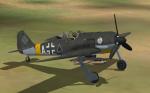
Focke Wulf Fw 190A-3/U3
Unit: ErgSchlGr - Schlachtfliegerschule, Deblin-Irena summer 1943
Pilot: various trainees being converted from level bomber and transport pilots
This aircraft was the /U3 fighter bomber variant.
The Fw 190 series entered combat with the A-1 model in September 1941 proving a huge shock to the RAF as it was clearly superior to the Spitfire V (which was the primary RAF fighter at the time) in everything except turning radius. However these early versions suffered from severe engine overheating problems and fires which kept serviceability rates low throughout 1941. This was somewhat solved in the field by JG26 technical officers by rerouting the exhaust pipes and opening cooling slots in the fuselage aft of the engine. These changes were introduced into the production line for the following A-2 models which began arriving in December 1941.
The Fw 190 A-3 began deliveries in the spring of 1942 with the change to the more powerful BMW 801D-2 1700hp engine using 96 octane fuel, replacing the unreliable BMW 801C-1 in the Fw190 A-2. Fw 190A-3 was externally identical to the A-2, which makes the two variants extremely difficult to tell apart. The only positive visual clues could only be seen up-close: the C3 fuel triangles and the Werknummer. Like the A-2, it had two cowl mounted MG 17 machine guns, two inboard wing mounted MG 151 20mm cannons with protruding barrels and wing root blisters, plus two MG FF 20mm cannons in outboard positions, with underwing bulges. The slower firing MG FF cannons with its limited 90 rpg were often removed in the field and panel bulges replaced with flat panels.
Besides the difference in the number of wing cannons, the only other major variant was the FW 190A-3/U3 fighter bomber which had an under-fuselage mounted bomb rack ETC 501 for carriage of 500 kg of bombs (1 500 kg, 1 250 kg or 4 50 kg on the ER4 adapter) or an external drop tank of 300 liter capacity for long range fighters. These usually had the retractable small gear cover doors removed which would interfere with the ordinance loads.
By early 1943, 509 A-3s had been built. By mid 1943 it was being relagated to opertional training organizations.
--------------------------------------------------------------------------------------------------------------------------------------------------------------------
Captain Kurt developed the model using some parts of the Design Team Daedalus Fw 190D-9 model, which in turn was developed from the old Pstrany Dora model by Captain Kurt - with permission. The new model added multiple details, new parts, new VC, and animations. The air files are a further development of the Design Team Daedalus FW 190 series.
Captain Kurt also created the camouflage paints, and the 2D instrument panel.
Keticheart: prop blur .bmp
AliCat: o2 Wachter and Sauerstoff guages
FSD: most of the gauges
other gauge authors are unknown
Posted Jan 12, 2026 16:16 by Captain Kurt
13.47Mb (74 downloads)
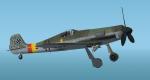
The Focke-Wulf Ta 152 is a German high-altitude fighter–interceptor designed by Kurt Tank and produced by Focke-Wulf. It entered production too late and in insufficient numbers to have a significant role in the Second World War.
The Ta 152 was a development of the Focke-Wulf Fw 190 fighter. In 1944, the Reichsluftfahrtministerium (German Air Ministry) decided that new fighter aircraft titles must include the chief designer's name. The aircraft design was therefore given the prefix Ta for Kurt Tank. It was intended to be produced in at least three versions—the Ta 152H Höhenjäger (high-altitude fighter) which was to be equipped with MW-50 methanol boost for altitudes up to 30,000 feet and GM-1 nitrous oxide boost for altitudes above that.; the Ta 152C designed for medium-altitude operations and ground-attack, using a Daimler-Benz DB 603 and with smaller wings and the Ta 152E fighter–reconnaissance aircraft with the engine of the H model and the wing of the C model. Only the H model was produced, the first Ta 152H entered service with the Luftwaffe in January 1945; one month later production of the Ta 152 had ceased due to Germany's declining position in the conflict.
Credits
Aircraft Model, VC, paint textures, and 2D panel: Captain Kurt - I guess I can't really call this a Team Daedalus project anymore as I am the only remaining member still active. However I need to recognize Paul Straney as my modeling mentor and his previous modeling work on the many Team Daedalus Messerschmitts and the original Virtual Wings Fw 190 Doras which has guided my efforts.
Pilot figure: Shessi
Prop blur: Keticheart:
Gauges: o2 Wachter and Sauerstoff gauges by AliCat, most of the gauges by FSD, and other gauges by Microsoft or authors unknown
Sound files: Lawdog2360
Flight Files: Uses the 714/257th 1% project version 2.80.57 Ta 152H flight files. They are closer to performance specs than I have been able to achieve.
Drop tank and rack: Pstrany / Virtual Wings
Posted Jan 7, 2026 20:04 by Captain Kurt
3.70Mb (52 downloads)
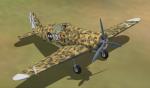
Fiat G.50 Series I
Unit: Reparto Sperimentale G.50, Aviazione Legionaria, Escalona Spain May 1939
The FIAT G.50 Freccia (Freccia means Arrow in English) was first flown in February 1937. The G.50 was Italy's first single-seat, all-metal monoplane with an enclosed cockpit and retractable landing gear to go into production. Pilots disliked the sliding cockpit canopy, which was not easy to open quickly. So, in later production series, an open cockpit was adopted.
The first series I aircraft were delivered to the Regia Aeronautica in 1938. An experimental unit, the Reparto Sperimentale G.50, was formed for operational evaluation of the G.50. In January 1939, the unit flew to Spain with 12 G.50's. For some reason, none of the aircraft had landing gear doors. By that time, most of the air war there was finished and the G.50s never met enemy aircraft. Very maneuverable, it was one of the best fighters during the Spanish Civil War. But by the time World War II began it was becoming obsolescent, being too slow because it was underpowered and underarmed with only two Breda-SAFAT 12,7mm machine guns.
Credits
Captain Kurt: Aircraft model, VC, paint textures, aircraft flight files, and .dp
Kelticheart: Prop blurred texture
Gauges, as far as I know, credit goes to kelticheart, mvg3d, Chalachew, Beepee, and Gius for their WWII Italian gauges.
The panel, much modified, is based on an IL-2 panel.
Posted Jan 7, 2026 04:57 by Captain Kurt
3.50Mb (40 downloads)
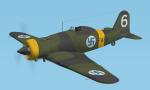
Fiat G.50 Series I Finland
Unit: 1/LeLv26 Kilpasilta, Finland Mar 1943 (this aircraft had 5 victories with various pilots)
Pilot: L. Kalkkinen
The FIAT G.50 Freccia (Freccia means Arrow in English) was first flown in February 1937. The G.50 was Italy's first single-seat, all-metal monoplane with an enclosed cockpit and retractable landing gear to go into production. Italian pilots disliked the sliding cockpit canopy, which was not easy to open quickly. So, in later production series, an open cockpit was adopted.
Fourteen G.50 were drawn from the first Series I production batch and shipped to Finland in January of 1940. They were assigned to LeLV 26, then stationed at Utti, but the unit was still in training when the so called Winter War with Russia ended with a peace treaty in March 1940. The enclosed cockpit canopies perspex began yellowing and fogging leading to the removal of the sliding canopies and painting over the fixed rear canopies.
Twenty one more G.50s were delivered during 1940 (two lost in transit), this time from the Series II version. Finland declared war on the Soviet Union on June 25, 1941 after the Russians bombed several Finland cities. With LeLv26, The G.50 saw its longest and most successful service in the two Finnish wars against the Soviet Union, the Winter War of 1939 1940 and the Continuation War of 1941 1944. Overall, LeLv 26 achieved 52 kills against only 2 losses in combat.
Credits
Captain Kurt: Aircraft model, VC, paint textures, aircraft flight files, and .dp
Kelticheart: Prop blurred texture
Gauges, as far as I know, credit goes to kelticheart, mvg3d, Chalachew, Beepee, and Gius for their WWII Italian gauges.
The panel, much modified, is based on an IL-2 panel.
Posted Jan 7, 2026 04:53 by Captain Kurt
3.70Mb (45 downloads)
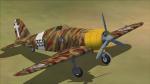
Fiat G.50 bis
Unit: 352 Squadriglia, 20 Gruppo at Pantelleria 1941 - later transferred to Libya
The FIAT G.50 Freccia (Freccia means Arrow in English) was first flown in February 1937. The G.50 was Italy's first single-seat, all-metal monoplane with an enclosed cockpit and retractable landing gear to go into production. Pilots disliked the sliding cockpit canopy, which was not easy to open quickly. So, in later production series, an open cockpit was adopted.
It was employed in all the Regia Aeronautica area operations in the Mediterranean and North Africa for fighter defense, convoy escort and bomber escort missions. In the Greek campaign, it performed adequately against opposing obsolescent types like the Gladiator and Blenheim. After that it was clear it was not a match for more modern Allied aircraft and was eventually used more for ground attack.
Credits
Captain Kurt: Aircraft model, VC, paint textures, aircraft flight files, and .dp
Kelticheart: Prop blurred texture
Gauges, as far as I know, credit goes to kelticheart, mvg3d, Chalachew, Beepee, and Gius for their WWII Italian gauges.
The panel, much modified, is based on an IL-2 panel.
Posted Jan 7, 2026 04:52 by Captain Kurt
6.02Mb (40 downloads)
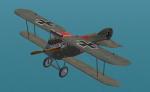
Phönix D.I / D.II
The Phönix D.I biplane was intended as a replacement for the Hansa-Brandenburg D. I. It was produced in smaller numbers (120 D. I, 45 D. II, and 48 D. IIa fighters) than the Hansa-Brandenburg. The Phönix D.I began production in August 1917 and the D.II replaced the D.I in production in March 1918 . The Phönix D-series fighters are generally considered the best fighters designed and produced in Austria-Hungary.
Previously, the Phönix Flugzeug-Werke firm had been contracted to produce the Hansa-Brandenburg D.I fighter under license. It became apparent by 1917 that the infamous Star-strutter could not be developed further, and the company embarked on a new aircraft. The design eventually incorporated a fuselage similar to the D.I and also sported wings of unequal span that ended in rounded wingtips. It was also considerably more powerful, with a Hiero 200- horsepower engine. It located the machine guns within the engine cowling which enhanced streamlining but placed the guns beyond the pilot’s reach if they jammed. The resulting craft was faster in level flight but somewhat unstable and slow-climbing. In December 1917 it entered service as the Phönix D.I and was deployed with army and navy units. The new machine was far from perfect, but it represented a dramatic improvement over the earlier Star-strutter, proving to be a match for Allied fighters.
The Phönix D.II fighter was designed to improve performance and maneuverability. The wing dihedral was eliminated, new high aspect ailerons, a new tail plane design with balanced elevators quickened aircraft response. The D.IIa was identical but used an up rated Hiero 230 hp engine. The D.II entered service in May 1918.
---------------------------------------------------------------------------------------------------------------
The model, textures. panel and air files are by Captain Kurt. The pilot figures were developed from Wolfi's freeware Japanese pilot .fsc source file. The prop spinning texture is by Kelticheart.
Gauges are by Martin Klein with texture change outs by Captain Kurt, .
Posted Dec 30, 2025 15:07 by Captain Kurt