


CFS2 > Page 2
5.98Mb (24 downloads)
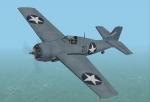
Grumman F4F-4 Wildcat VF-6 USS Enterprise (CV 6) Machinist Mate Donald Runyon, E. Solomons August 28, 1942
The Wildcat was the only effective fighter available to the United States Navy and Marine Corps in the Pacific from 1941 to 1943. While the Wildcat was still outperformed by the faster, more maneuverable, and longer ranged Mitsubishi A6M Zero, the F4F's ruggedness combined with effective US pilot's tactics made it more successful in combat. The first operational version, the F4F-3 had a fixed wing which limited the number a fleet aircraft carrier could operate to 18. Grumman had proposed incorporating a folding wing to the Wildcat in 1940 and the Navy had awarded a contract for the F4F-4 in 1941. The folding wings would allow the fleet carriers to operate 27 Wildcats. The Battle of the Coral Sea had proved the need for more fighters for CAP and escort, and the Navy rushed to replace the fixed wing F4F-3 with the new F4F-4 before the next inevitable carrier battle which turned out to be Midway. Navy and Marine pilots weren't thrilled with the F4F-4 as it was heavier, less maneuverable, and had added 2 more machine guns which reduced the ammunition to each and reduced the firing time. But it was what they had. They made the most of it that they could, and held the line through 1943.
Credits
Captain Kurt: Aircraft model, drop tank, bomb rack, bomb, VC, paint textures, aircraft flight files, and .dp
Shessi: Pilot figure
Morton: 2D F4F instrument panel modified to an F4F-3 version
Kelticheart: Prop blurred texture
Microsoft: Gauges and .air file
Posted Apr 8, 2026 15:25 by Captain Kurt
6.27Mb (24 downloads)
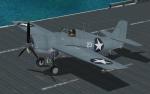
Grumman F4F-4 Wildcat VF-3 USS Yorktown (CV5) Lt. Commander John Thach, Midway June 4, 1942
The Wildcat was the only effective fighter available to the United States Navy and Marine Corps in the Pacific from 1941 to 1943. While the Wildcat was still outperformed by the faster, more maneuverable, and longer ranged Mitsubishi A6M Zero, the F4F's ruggedness combined with effective US pilot's tactics made it more successful in combat. The first operational version, the F4F-3 had a fixed wing which limited the number a fleet aircraft carrier could operate to 18. Grumman had proposed incorporating a folding wing to the Wildcat in 1940 and the Navy had awarded a contract for the F4F-4 in 1941. The folding wings would allow the fleet carriers to operate 27 Wildcats. The Battle of the Coral Sea had proved the need for more fighters for CAP and escort, and the Navy rushed to replace the fixed wing F4F-3 with the new F4F-4 before the next inevitable carrier battle which turned out to be Midway. Navy and Marine pilots weren't thrilled with the F4F-4 as it was heavier, less maneuverable, and had added 2 more machine guns which reduced the ammunition to each and reduced the firing time. But it was what they had. They made the most of it that they could, and held the line through 1943.
Credits
Captain Kurt: Aircraft model, drop tank, bomb rack, bomb, VC, paint textures, aircraft flight files, and .dp
Shessi: Pilot figure
Morton: 2D F4F instrument panel modified to an F4F-3 version
Kelticheart: Prop blurred texture
Microsoft: Gauges and .air file
Posted Apr 8, 2026 15:23 by Captain Kurt
4.85Mb (37 downloads)
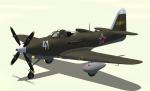
Bell P-63C Kingcobra
Unit: 16th GvIAP VVS Siberia/Mongolia
Bell designed the P-63 with the intention of improving the high altitude performance failure of the P-39 Airacobra. Although similar looking, the P-63 was a totally new aircraft; being larger with a laminer flow wing, supercharging,etc. Despite its improvements, the P-63 never lived up to the level of the P-51, Corsair, or other late-war front line fighters. The P-63 never saw combat in USAAF squadrons. Some 76% of the 3300 planes went to the Soviet Union, where their service record is largely unknown. The Soviets were have spin recovery issues with the first production version, the P-63A, and demanded a fix. Bell responded with the P-63C, adding a fin under the rear fuselage and shifting some of the aircraft CG which solved the problems.
The US Army Air Force (USAAF) order for two prototypes in June 1941 launched the P-63 Kingcobra. Further prototypes followed before deliveries of the first production version began in October 1943.
Production deliveries of the P-63A began in October of 1943. The USAAF never saw fit to use the Kingcobra for operational combat missions, since by that time in the war the need for a high altitude fighter was met by the P-38 and P-51, and low-altitude close-support fighter aircraft was more than adequately filled by such aircraft as the P-47 Thunderbolt.
However, the Soviet Union had a need for a high-altitude fighter (where the P-39 was deficient), and excellent ground attack capabilities using the 37-mm cannon. The US Army directed the production of the Kingcobra to the Soviet s lend-lease program.
The Russians used the P-63C Kingcobra primarily in the far east after declaring war on Japan in August 1945, Its mission was for close-support and ground strafing. The Kingcobra had a relatively good low-altitude performance and had the ability to absorb a lot of battle damage and still remain flying. It proved to be a potent ground attack aircraft and tank-buster, but it never received the amount of attention in the Soviet Union as did the Ilyushin Il-2 Shturmovik.
Credits
Captain Kurt: Aircraft model, drop tank, VC, paint textures, 2D panel.
ACWai contributed the landing gear designs.
Shessi: Pilot figure
Kelticheart: Prop blurred texture
Gauges: AliCat, ACWai, Microsoft, and others unknown
714/257th 1% Aircraft: aircraft.cfg, air file, and .dp
Posted Mar 31, 2026 15:57 by Captain Kurt
4.87Mb (28 downloads)
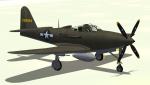
Bell P-63A Kingcobra
Bell designed the P-63 with the intention of improving the high altitude performance failure of the P-39 Airacobra. Although similar looking, the P-63 was a totally new aircraft; being larger with a laminer flow wing, supercharging, etc. Despite its improvements, the P-63 never lived up to the level of the P-51, Corsair, or other late-war front line fighters. The P-63 never saw combat in USAAF squadrons. Some 76% of the 3300 planes went to the Soviet Union, where their service record is largely unknown. Another 300 planes went to the Free French squadrons, seeing Viet Nam action.
The US Army Air Force (USAAF) order for two prototypes in June 1941 launched the P-63 Kingcobra. Further prototypes followed before deliveries of the first production version began in October 1943.
Production deliveries of the P-63A began in October of 1943, and by December of 1944 1725 P-63As had been produced. The USAAF never saw fit to use the Kingcobra for operational combat missions, since by that time in the war the need for a high altitude fighter was met by the P-38 and P-51, and low-altitude close-support fighter aircraft was more than adequately filled by such aircraft as the P-47 Thunderbolt. Regardless, P-63As did serve for a few months with the 31st, 444th, and 445th Squadrons while they were based Stateside.
Credits
Captain Kurt: Aircraft model, drop tank, VC, paint textures, 2D panel.
ACWai contributed the landing gear designs.
Shessi: Pilot figure
Kelticheart: Prop blurred texture
Gauges: AliCat, ACWai, Microsoft, and others unknown
714/257th 1% Aircraft: aircraft.cfg, air file, and .dp
Posted Mar 31, 2026 15:54 by Captain Kurt
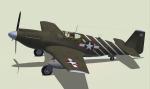
7.13Mb (30 downloads)
North American P-51A Mustang
Unit: 1st Air Commando Group
The P-51A served mainly as a fighter and escort in the China/Burma/India theatre (CBI). Modified versions called the F-6B, were fitted with camera equipment for recon and served in the ETO. The P-51A would see service into 1945, long after replacement models were in service. Production would be cut far short of the 1,200 ordered. As soon as the Rolls Royce Merlin modifications to the P-51 were deemed worthy, production was shifted to the new models. In all, 310 P-51As were produced by NAA.
Designated NA-99, the P-51A Mustang was ordered in numbers of 1,200 by the U.S. Army in August 1942. No ground attack here, no dive brakes, just pure fighter. This was the best fighter the U.S. had below 22,000 feet. This according to the AAF School of Applied Tactics at Orlando, FL.
The P-51A was powered by the Allison V-1710-81 which had automatic boost control and rated at 1,200 horsepower. This Allison had increased performance at altitude over the V-1710-39 used in the P-51. The propeller was a 3-blade, 10 feet 6 inch Curtiss electric. Top speed was 415 mph at 10,000 feet and the service ceiling was 31,500 feet. There were two underwing mounts for bombs or drop tanks. Gross weight increased to 10,600 lbs. max with an average load of 8,600 lbs.
Credits
Captain Kurt: Aircraft model, drop tank, VC, paint textures, 2D panel, aircraft.cfg, air file, and .dp
Shessi: Pilot figure
Kelticheart: Prop blurred texture
Other ordinance: FDG Team
Gauges: AliCat, ACWai, Microsoft, and others unknown
Sound: razcal -- The Allison V-1710-81 for the P-40 but same engine in the P-51A
Posted Mar 18, 2026 15:21 by Captain Kurt
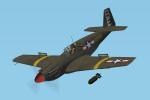
10.84Mb (23 downloads)
North American A-36A Invader
Unit: 533Rd FBS, 27th FBG at Sicily 1943
April 1942 marked the first order of any P-51 variant by the US Army. 500 NA-97s were ordered. The U.S. serials were 42-83663 to 42-84162. The P-51 was never intended to be a dive bomber. Budgets for pursuit fighters were limited at that time, but there were funds available for dive bombers. NAA's President, Dutch Kindelberger, made proposals for a quick design modification to the P-51 and landed a contract for 500 A-36A's.
Although "Apache" was the A-36A's official name, it was rarely used.Units in Africa and Italy called it the "Invader" and the name eventually found its way into offical USAAF use.
The design was very similar to the Mustang I and P-51A. The powerplant was the Allison V-1710-87. The A-36 was a dive-bomber so the addition of hard points for two 500 lb bombs and dive brakes to slow the fast acceleration of the P-51 in a dive were added. The belly scoop was now fixed at the front. Armament was 2 guns in the nose and 4 in the wings, all .50 caliber.
The dive brakes were operated hydraulically and located on the top and bottom of each wing outboard of the guns. Plan was that they limit the dive speed to 250 mph but in practice the speeds were closer to 350 mph and higher. The angle of dive was reduced to 70 degrees because of high stress during pull-out.
The hard points for the bombs were also capable of holding 75 gallon drop tanks for extended range. The top speed of the A-36 was down from added weight to about 358 mph at 5,000 feet (without external stores).
The US used the A-36 in the Mediterranean theatre with first deliveries beginning in early 1943. When not in the ground attack role, the A-36 was essentially a low-altitude P-51A and was used as a fighter. The A-36 scored 101 air-air victories during WWII.
The A-36 proved to be a very stable platform for accurate weapons delivery. 177 were lost in action mostly due to the dangerous mission of low-level operations.
Credits
Captain Kurt: Aircraft model, drop tank, VC, paint textures, 2D panel, aircraft.cfg, air file, and .dp
Shessi: Pilot figure
Kelticheart: Prop blurred texture
Other ordinance: FDG Team
Gauges: AliCat, ACWai, Microsoft, and others unknown
Sound: razcal -- The Allison V-1710-81 for the P-40 but same engine in the P-51A
Posted Mar 18, 2026 15:18 by Captain Kurt
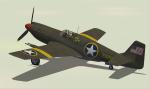
7.16Mb (26 downloads)
North American P-51 / F-6A Mustang
Unit:154th Tactical Reconnaissance Squadron, Tunesia April 1943
Pilot: Lt. Alfred C. Schwab
For aid to Great Britain under the Lend-Lease program, the USAAF ordered 150 model P-51 Mustangs with a Letter of Intent on 7 July 1941. Four 20mm cannon replaced the mixed caliber machine gun arrangement of the British Mk I Mustang. As production of the P-51 airplanes ramped up in late 1941, it was decided that the USAAF would retain fifty-eight of the 150. The first example (41-37320) was delivered to the USAAF as the one-of-a-kind P-51-1-NA to serve as the prototype F-6 photographic reconnaissance and mapping variant. Another 54 were delivered as P-51-2-NA airplanes that were modified to serve as photo reconnaissance planes. In the summer of 1942 these 55 were re-designated as F-6A-1-NA rather than P-51-1/2 airplanes. One P-51 (41-37426) was acquired by the US Navy for aircraft carrier sea trials and was assigned US Navy Bureau Number 57987. The last of the keepers were two P-51s (41-37352 and 41-37421) which were retained to become the XP-51B airplanes. Therefore, the RAF only received 92 of these aircraft as Mustang Mark IA airplanes instead of the 150 it had requested. It's been written that the F6 modification included installation of two K-24 cameras behind the pilot s seat or alternatively, that one was behind the pilot seat and one in the rear fuselage. However contemporary photos show only the single camera behind the pilot seat and never any second camera.
Credits
Captain Kurt: Aircraft model, VC, paint textures, 2D panel, aircraft.cfg, air file, and .dp
Shessi: Pilot figure
Kelticheart: Prop blurred texture
Gauges: AliCat, ACWai, Microsoft, and others unknown
Sound: razcal -- The Allison V-1710-81 for the P-40 but same engine in the P-51A
Posted Mar 18, 2026 15:14 by Captain Kurt
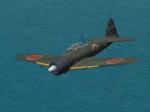
9.40Mb (41 downloads)
A6M5 ZERO
Aircraft of 381ku based at Kendari, Dutch East Indies circa March 1944
Visual model: Captain Kurt
VC: acwai
Airfile: UncleTgt
Texture file: painted by UncleTgt and acwai.
Gauges: These gauges were designed by Alphasim, Mape, Aussie, or some unknown author. I have made some modifications.
Weapons: Captain Kurt
This is a copyrighted freeware program.Use this program at you own risks, the
author is not responsible for any damages done to your computer.
Thanks for downloading this aircraft, have fun!
Andrew Wai
Posted Mar 9, 2026 01:51 by ACWai, Captain Kurt and UncleTgt
9.65Mb (27 downloads)
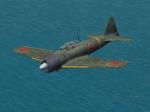
A6M3 model 32 ZERO
Aircraft from 204ku, flying from Kahili, Bougainville during the summer of 1943. Pilot was W/O Matsuo Hagiri.
Visual model: Captain Kurt
VC: acwai
Airfile: UncleTgt
Texture file: painted by UncleTgt and acwai.
Gauges: These gauges were designed by Alphasim, Mape, Aussie, or some unknown author. I have made some modifications.
Sound: CFS2 stock sound
Weapons: Captain Kurt
This is a copyrighted freeware program.Use this program at you own risks, the
author is not responsible for any damages done to your computer.
Thanks for downloading this aircraft, have fun!
Andrew Wai
Posted Mar 9, 2026 01:49 by ACWai, Captain Kurt and UncleTgt
8.69Mb (30 downloads)
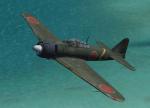
A6M3 model 22_ZERO VERSION 1.0 FEB 2026
582ku Rabaul, April 1943
Visual model: Captain Kurt
VC: acwai
Airfile: UncleTgt
Texture file: painted by UncleTgt and acwai.
Gauges: These gauges were designed by Alphasim, Mape, Aussie, or some unknown author. I have made some modifications.
Weapons: Captain Kurt
This is a copyrighted freeware program.Use this program at you own risks, the
author is not responsible for any damages done to your computer.
Thanks for downloading this aircraft, have fun!
Andrew Wai
Posted Mar 9, 2026 01:47 by ACWai, Captain Kurt and UncleTgt