



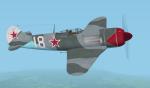
4.20Mb (26 downloads)
Lavochkin La-7
Unit: 176 GIAP February 1945 Germany
Pilot: Major Aleksandr S. Kumanichkin 35 total victories
The La-7 entered combat in June 1944 during the opening phase of Operation Bagration, the massive Soviet offensive that destroyed Army Group Center. Equipped with the new fighter, elite Guards regiments immediately established air superiority over the battlefield, allowing Il-2 Shturmoviks and Pe-2 dive-bombers to operate with increasing freedom. Luftwaffe pilots who had been accustomed to qualitative superiority over Soviet fighters found the La-7 an unsettling opponent, faster, with better climb, and flown by increasingly experienced Soviet pilots. The kill-to-loss ratios achieved by Soviet Guards regiments in the war's final months were the best of the entire Eastern Front war, a stark reversal from the catastrophic ratios of 1941.
The La-7 also saw limited postwar combat service. North Korean Air Force La-7s were used in the opening stages of the Korean War in June-July 1950, though they were quickly swept aside by USAF F-80 Shooting Star jets and even by propeller-driven F-51 Mustangs whose pilots had greater experience and training.
Credits
Captain Kurt: Aircraft model, VC, 2D panel. paint textures, and .dp
aircraft flight files: Thicko
Kelticheart: Prop blurred texture
Gauges: Most are by Morton for the Br Yak-9U others by authors unknown
Bombs, rockets, and racks are from Ivan Hsu's I-16 series
Posted Oct 20, 2026 17:26 by Captain Kurt
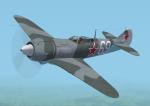
4.84Mb (39 downloads)
Lavochkin La-5FN V.3 upgraded with operating cowl air cooling shutters
Unit: 3 GvIAP KBF June 1944 (VVS Baltic Fleet)
Pilot: Captain Ivan Savelievich Kravtsov, 31 personal and 4 shared victories, HSU, 4x Orders of the red Banner
Same blah,blah as version 1 of this plane.
Credits
Captain Kurt: Aircraft model, VC, 2D panel. paint textures, and .dp
aircraft flight files: Thicko
Kelticheart: Prop blurred texture
Gauges: Most are by Morton for the Br Yak-9U others by authors unknown
Bombs, rockets, and racks are from Ivan Hsu's I-16 series
Posted Oct 14, 2026 17:56 by Captain Kurt
0.00Mb (17 downloads)
This is a .dp file fix to have both cannons fire.
Posted Oct 8, 2026 16:31 by Captain Kurt
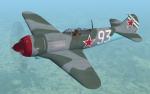
20.20Mb (50 downloads)
Lavochkin La-5FN
Unit: 32 GIAP aircraft flight files,
Pilot: Captain Vladimir Orekhov -- He ended the war with 19 personal victories
The La-5FN's story begins with one of the most remarkable engineering rescues of the war. In 1942, Semyon Lavochkin's LaGG-3 fighter, nicknamed the "lacquered guaranteed coffin" by its pilots, was one of the worst Soviet fighters in service. Underpowered, heavy, and sluggish, the LaGG-3 was being slaughtered by Bf 109s. Lavochkin's design bureau faced closure. In a desperate gamble, he replaced the LaGG-3's inline Klimov engine with the available Shvetsov M-82 radial engine, creating the LaG-5 (soon redesignated La-5) almost overnight.
The La-5 was a massive improvement over the LaGG-3, but it still had significant problems. The carbureted M-82A engine was unreliable and difficult to maintain. The breakthrough came with the ASh-82FN engine. The combination of the FN engine with Lavochkin's refined airframe produced the La-5FN, which entered production in March 1943.
The La-5FN was superior to the Bf 109G-2 in speed below 20,000 feet, in rate of climb below 16,000 feet, and in horizontal maneuverability at all altitudes. For the first time since the German invasion, a Soviet fighter could claim genuine qualitative parity with the best Luftwaffe equipment.
Credits
Captain Kurt: Aircraft model, VC, 2D panel. paint textures, and .dp
aircraft flight files: Thicko
Kelticheart: Prop blurred texture
Gauges: Most are by Morton for the Br Yak-9U others by authors unknown
Bombs, rockets, and racks are from Ivan Hsu's I-16 series
Posted Oct 8, 2026 00:59 by Captain Kurt
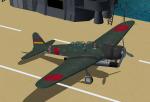
5.90Mb (57 downloads)
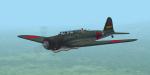
Nakajima B5N2 Kate
Unit: Akagi Air Group
Pilot:flown by Lt.JG Jinichi Goto on December 7, 1941 Pearl Harbor Attack. It's torpedo hit the USS Oklahoma.
The B5N2 was officially adopted in December 1939 as a follow-up of the B5N1. Allied code-named “Kate,” the B5N2 was a highly maneuverable aircraft for its type, powered by one Nakajima Sakae 21, a twin-row 14-cylinder 1000 hp radial engine. With a top speed of 235 mph, it had a operational range of 610 miles. A three-man crew was standard. Its armament featured one 7.7mm machine gun for rearward defense and payload capacities of either: one 800kg bomb, two 250kg bombs, six 60kg bombs, six 30kg bombs, or one 800kg torpedo. The B5N2 was given a more powerful engine and streamlined a bit to try and make it capable of outrunning enemy fighters. the B5N2 Type 97 proved to be an accurate bombing and torpedo platform and equipped all six IJN carriers in the Nagumo task force that attacked the U.S. Pacific Fleet in the Pearl Harbor raid. The type 97 became the Navy’s mainstay in the early stages of the war wherever it saw extensive action, including combat campaigns in the Solomons, Southwest Pacific, and Indian Ocean. It was very successful in the early stages of the war, more because of it’s superbly trained aircrews, than any outstanding performance on the aircraft’s part. The B5N2 was becoming obsolete by the end of 1942. It was replaced by the B6N Tenzan starting in 1943, but continued to serve right through to the end of the war.
This package includes the following weapons:
Type 91 Torpedo
Type 91 Torpedo with wooden tail as used at Pearl Harbor
Type 80 800 Kg bomb
Type 98 250 Kg bomb
Type 97 60 Kg bomb
B5N2 torpedo rack
B5N2 bomb rack for 6x60Kg bombs
B5N2 bomb rack for 250Kg bombs
B5n2 bomb rack for 800Kg bomb
-------------------------------------------------------------------------------------------------------------------------
Credits
Aircraft model, VC, panel.cfg, dp, weapons models, and textures are by Captain Kurt
The pilot figures are Wolfi's freeware Japanese pilot .fsc source file.
The prop spinning texture is by Kelticheart.
The 2D panel background image is freeware by Phil Perrott of AlphaSim
The gauges are by Microsoft, JWB, ACWai, FDG2, and Mopar Mike
The air files from the Overhauled B5N2 Kate by The B24Guy
Posted Sep 5, 2026 21:58 by Captain Kurt
4.67Mb (59 downloads)
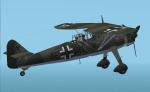
Henschel Hs 126A-1
Unit: 1.(H)13, location unknown, 1942
Pilot: unknown
The Henschel Hs 126 was a Luftwaffe two-seat parasol wing reconnaissance and observation aircraft designed and produced by the German aircraft manufacturer Henschel. By 1939, it had become the principal short-range reconnaissance aircraft of the Luftwaffe.
The pilot was seated under the parasol wing and the observer in an open rear cockpit. In the autumn of 1936, the first prototype made its maiden flight; it was soon followed by two more prototypes and a batch of pre-production aircraft. An odd feature was the entire tail unit was angled 2 degrees from the centerline. During early 1938, the Hs 126 underwent service evaluation; it was well received for its good short takeoff performance and low-speed flight characteristics, attributes that were useful during its operational history. The first production standard Hs 126A-1s came of Henschel's production line in early 1938; this model differed from the pre-production aircraft mainly in terms of their fitout, being powered by a BMW 132Dc radial. A total of 257 Hs 126s had been delivered to the Luftwaffe by the start of the Second World War. Production of the Hs 126 was terminated during January 1941, after some 600 had been produced.
The Hs 126 saw combat on numerous fronts, the first occasion being with the Legion Condor contingent that participated in the Spanish Civil War. It was active on numerous fronts of the Second World War. Large numbers of Hs 126s flew during the Invasion of Poland, the Battle of France, North Africa, and the Invasion of the Soviet Union. On 12 September 1943, a number of Hs 126s were used to tow ten DFS 230 attack gliders from Pratica Di Mare airfield near Rome to the Gran Sasso on
a raid to rescue Benito Mussolini. The Royal Hellenic Air Force also operated 16 Hs 126s, which saw action during the Greco-Italian War. It was withdrawn from Luftwaffe service in 1943, by which point the Hs 126 had been superseded by the
Fieseler Fi 156 Storch, a general-purpose STOL aircraft, as well as the twin-boom Focke-Wulf Fw 189 Uhu.
Credits
Captain Kurt: Aircraft model, VC, paint textures, panel, aircraft flight files, and .dp
The crew figures are a mashup of Captain Kurt, Wolfi and Dave Eckert
Prop blurred texture: Kelticheart
Gauges: Groundcrew Design Group, Microsoft and others unknown
Posted Jul 25, 2026 18:42 by Captain Kurt
8.42Mb (59 downloads)
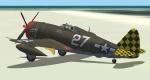
Republic P-47D-16-RE Thunderbolt 42-75971 "Ruthless Ruthie"
Unit: 317th Fighter Squadron 325th Fighter Group, Italy 1944
Pilot: Lt George P Novotny (Ace w/ 8 victories), then Lt John Simmons
The U.S. Army Air Force’s P-47 Thunderbolt was a very effective fighter and fighter bomber. It was ruggedly built and heavily armed, famed for its ability to absorb damage, bringing its pilot home after inflicting punishment on the enemy.
The P-47D-16 Was an ongoing refinement of the P-47 line, having adding more armor protection for the pilot, fuel and oxygen systems, improvements to the turbocharger ducting, two additional cowl flaps on either side of the cowling to improve engine cooling, and added water/alcohol mix injection to provide an emergency power boost of 15% for a short period. The p-47D-15 production block added stronger wings and for the first time, the wings were fitted with under-wing pylons that could carry two drop tanks, or up to 2,000 lbs. of bombs. 653 built. The lower 2 cowl flaps were trimmed back in the shape that was retained for all the future P-47 production. The D-16 block was virtually identical to the D-15 differing only in some minor fuel system changes,
Ruthless Ruthie led a strange life. First it was the mount of an 8 kill ace, Lt George P Novotny, then later to Lt. John Simmons who scored no victories in it. Then it was lost on ferry mission, landing in error at Rome-Littorio on 29th May 1944, apparently flying the correct distance on a ferry flight but with 180 deg wrong direction. The pilot was 2nd Lt Lloyd Hathcock who became a POW. From there it was test flown by the Luftwaffe at Rechlin coded "8+6" and later transferred to "Zirkus Rosarius" on Oct 12, 1944, and flown as T9+LK. It was found by US troops at Gottingen at the end of the war.
Credits
Captain Kurt: Aircraft model, drop tanks, VC, paint textures, panel, and .dp
Pilot figure: Shessi and Captain Kurt
flight files: Jay McDaniel (modified to match P-47D performance)
Prop blurred texture: Kelticheart
Gauges: Alicat, Morton, Microsoft and others unknown
Posted Jun 28, 2026 16:46 by Captain Kurt
8.16Mb (43 downloads)
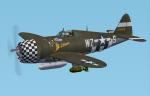
Republic P-47D-11-RE Thunderbolt
Unit: 84th Fighter Squadron, 78th Fighter Group, Duxford England June/July 1944
Pilot: Lt. Frank E. Oiler
The U.S. Army Air Force’s P-47 Thunderbolt was a very effective fighter and fighter bomber. It was ruggedly built and heavily armed, famed for its ability to absorb damage, bringing its pilot home after inflicting punishment on the enemy.
The P-47 was conceived and engineered to be a high-altitude interceptor. Its designed purpose was to act in a defensive role, destroying attacking hostile bombers. However, by the time the P-47 became operational, it had become clear to military planners that an air attack on the continental United States was highly unlikely. Newly classified as an escort fighter, the first P-47Cs were sent to England to escort bomber missions.
The P-47 D-11 Was a further refinement of the P-47 line, adding more armor protection for the pilot, fuel and oxygen systems, improvements to the turbocharger ducting, added two additional cowl flaps on either side of the cowling to improve engine cooling, and added water/alcohol mix injection to provide an emergency power boost of 15% for a short period.
Underwing pylons capable of carrying bomb and drop tanks did not appear until production block D-15. However the 78th FG and other groups in England installed the racks which could still carry bombs only. They were not made capable of using drop tanks because fitting the plumbing through the wing was a major refit issue. For some unknown reason the lower two cowl flaps were trimmed back to match the D-15 cowl flaps. Eileen wasn't the only 78th FG earlier block P-47 to receive this treatment.
Credits
Captain Kurt: Aircraft model, drop tank, VC, paint textures, panel, and .dp
Pilot figure: Shessi and Captain Kurt
flight files: Jay McDaniel (modified to match P-47D performance)
Prop blurred texture: Kelticheart
Gauges: Alicat, Morton, Microsoft and others unknown
Posted Jun 28, 2026 16:44 by Captain Kurt
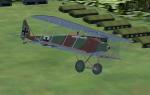
3.11Mb (61 downloads)
Halberstadt D.II
The Halberstadt D.II entered service in June 1916 at a time when the Fokker E.III Eindeckers had lost air supremacy to the Allies. Their good flying characteristics made them more popular than their contemporaries of the Fokker D.I-IV. Like other early German fighter types, the D.II was at first supplied in ones and twos to the ordinary reconnaissance units or Fliegertruppe of the Luftstreitkräfte, then gathered into small specialised fighter units – the Kampfeinsitzerkommandos.
When the first true fighter Jagdstaffeln were formed in mid-1916, the Halberstadt was initially the best fighter available, and was used by Oswald Boelcke to demonstrate his famous pioneering air fighting tactics (the Dicta Boelcke) to the new units. As the new Albatros fighters came into service the Halberstadts were quickly replaced, although a few survived into early 1917. Even Manfred von Richthofen flew a Halberstadt D.II for a few weeks in March 1917, after the spar of the lower wing of his Albatros D.III cracked in combat. He scored 6 of his 80 victories with the type. The Halberstadt was also supplied to the Ottoman Empire, serving in the Middle East theater.
---------------------------------------------------------------------------------------------------------------
CREDITS:
Captain Kurt: Model, textures. panel and air files.
Wolfi: Pilot figure was developed from his freeware Japanese pilot .fsc source file.
Kelticheart: Prop spinning texture
Martin Klein" Gauges are by Martin Klein (with a couple of texture change outs by Captain Kurt)
Posted Jun 13, 2026 16:34 by Captain Kurt

8.55Mb (58 downloads)
Republic P-47D-2-RE Thunderbolt
Unit: 340th Fighter Squadron, 348th Fighter Group, New Guinea 1944
Pilot: Lt. Col Robert R Rowland - 348th FG commanding officer after Col. Neel Kirby was transferred to HQ
The U.S. Army Air Force’s P-47 Thunderbolt was a very effective fighter and fighter bomber. It was ruggedly built and heavily armed, famed for its ability to absorb damage, bringing its pilot home after inflicting punishment on the enemy.
The P-47 was conceived and engineered to be a high-altitude interceptor. Its designed purpose was to act in a defensive role, destroying attacking hostile bombers. However, by the time the P-47 became operational, it had become clear to military planners that an air attack on the continental United States was highly unlikely. Newly classified as an escort fighter, the first P-47Cs were sent to England to escort bomber missions.
The P-47 D-2 Was a further refinement of the P-47C-5, adding more armor protection for the pilot, fuel and oxygen systems, improvements to the turbocharger ducting. It also added two additional cowl flaps on either side of the cowling to improve engine cooling.
As soon as the D-1 and D-2 production ramped up, enough P-47s became available for them to be deployed to other theaters. With that, the 348th Fighter Group, which was originally intended for England, was transferred to the SW Pacific instead where it compiled an outstanding operational record.
Credits
Captain Kurt: Aircraft model, drop tank, VC, paint textures, panel, and .dp
Pilot figure: Shessi and Captain Kurt
flight files: Jay McDaniel (modified to match P-47D performance)
Prop blurred texture: Kelticheart
Gauges: Alicat, Morton, Microsoft and others unknown
Posted Jun 4, 2026 14:53 by Captain Kurt