



CFS2 > Page 2
6.45Mb (50 downloads)
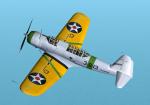
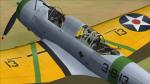
Vought SB2U-1 Vindicator
Unit: Scout Bombing Squadron (VB-3) aboard the USS Saratoga
Pilot: Flown by the leader of the 5th flight section
With the delivery of Vought-Sikorsky’s SB2U to the fleet on December 20, 1937, the US Navy took an important technological step. The airplane represented the service’s first monoplane scout-bomber whose speed eclipsed its predecessor in Navy bombing squadrons by 45 M.P.H. There were three versions of the airplane operated by the Navy and Marine Corps. The SB2U-1, of which 54 were ordered, was followed by 58 SB2U-2s delivered beginning in 1938 that differed only in weight, the result of extra equipment, externally it was identical.
By the time of World War II, the Vindicator suffered from the inherent flaw of being the ultimate development of the trussed fuselage and fabric concept, prompting their replacement by newer designs like the SBD Dauntless, which incorporated metal stressed skin construction techniques. Nevertheless, it was available and continued to serve in the Atlantic aboard the USS Ranger (Vs-41 and VS-42) on convoy escort and anti-submarine missions until the summer of 1942.
A later version, the SB2U-3, was developed for the US Marines having extra fuel tanks, a wider horizontal tail and provision for additional 50cal machine guns. As it was over 1,000lbs heavier with no power increase it was too sluggish for carrier operation, but it was only intended for land based Marine aviation.
The French bought 20 under the designation V-156-F in 1939 and placed a second order for an additional 50 in 1940. These could not be delivered before France fell and the British took over the contract naming the type as the Chesapeake.
Credits
Captain Kurt: Aircraft model, US Naval ordinance bombs, bomb racks, VC, paint textures, panel, flight, and .dp file.
Shessi: Pilot figures
Kelticheart: Prop blurred texture
BeePee: compass gauge
unknown: some gauges
Microsoft: Gauges and .air file
Posted May 20, 2026 17:38 by Captain Kurt
11.71Mb (58 downloads)
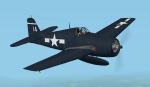
Grumman F6F-5 Hellcat VF-15
Unit: VF-15 USS Essex (CV-9) 1944
Pilot: Anon
The F6F-5 Hellcat was a further refinement of the successful F6F-3. It had a strengthened airframe, a closer cowl that eliminate the cheek bulges, added permanent rocket pylons under wings, a flat bullet proof front windscreen simplified the front canopy giving a better undistorted image through the gun sight especially at night, and the small rear windows were deleted with a rear view mirror installed as these windows added nothing to the rear view. (Some early dash 5 aircraft still had the rear windows before they were eliminated during production.) The camouflage for all of the F6F-5’s was changed to overall sea blue. It was built in the largest number of Hellcats, some 7,870 being produced.
Simple, rugged, and deadly, yet easy to fly, the Hellcat was another product of the Grumman Iron Works. It was larger, heavier, faster, and more powerful than Grumman's F4F Wildcat, and the first American fighter to exceed the performance of the Mitsubishi Zero. Its immense 18-cylinder, 2,000 horsepower radial engine gave it the power to dictate the terms of engagement. Its speed, maneuverability, high-altitude capability, and typical Grumman toughness made it a winner against all comers.
Credits
Captain Kurt: Aircraft model, drop tank, bomb racks, VC, paint textures, panel, aircraft.cfg and .dp
Shessi: Pilot figure
Kelticheart: Prop blurred texture
Microsoft: Gauges and .air file
Posted May 16, 2026 15:30 by Captain Kurt
6.53Mb (46 downloads)
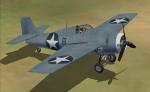
Grumman F4F-3 Wildcat VMF-212 Lt. Col. Harold W. Bauer, Guadalcanal September 1942
The original Grumman F4F-1 design was a biplane, which proved inferior to rival designs, necessitating a complete redesign as a monoplane, the F4F-2. This design was still not competitive with the Brewster F2A Buffalo which won initial U.S. Navy orders. Grumman completely rebuilt the prototype as the XF4F-3 with new non-folding wings and tail and a supercharged version of the Pratt & Whitney R-1830 "Twin Wasp" radial engine.Testing of the new XF4F-3 led to an order for F4F-3 production models, the first of which was completed in February 1940. The U.S. Navy officially adopted the aircraft type as the Wildcat. Armed with four .50 in (12.7 mm) Browning machine guns, it joined active units in 1940. At the time of Pearl Harbor, only Enterprise had a fully equipped Wildcat squadron, VF-6. By the end of February, 1942 the US Navy had replaced its Brewster F2A's with the F3F-3 and F3F-3A Wildcats.
The fixed wing F4F-3 Wildcat was generally outperformed by its major opponent the Mitsubishi Zero, but it was more successful in combat partly because, with relatively heavy armor and self-sealing fuel tanks, the Grumman airframe could survive far more damage. In the hands of an expert pilot with a tactical advantage, the Wildcat could prove a difficult opponent even against the formidable Zero. USN Commander "Jimmy" Thach devised a very effective defensive tactic that allowed Wildcat formations to act in a coordinated crossover maneuver to counter a diving attack, called the "Thach Weave".
Credits
Captain Kurt: Aircraft model, drop tank, bomb rack, bomb, VC, paint textures, aircraft flight files, and .dp
Shessi: Pilot figure
Morton: 2D F4F instrument panel modified to an F4F-3 version
Kelticheart: Prop blurred texture
Microsoft: Gauges and .air file
Posted May 7, 2026 15:37 by Captain Kurt
6.53Mb (42 downloads)
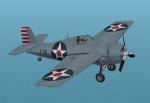
Grumman F4F-3 Wildcat VF-6 USS Enterprise (CV6) February 1, 1942
The original Grumman F4F-1 design was a biplane, which proved inferior to rival designs, necessitating a complete redesign as a monoplane, the F4F-2. This design was still not competitive with the Brewster F2A Buffalo which won initial U.S. Navy orders. Grumman completely rebuilt the prototype as the XF4F-3 with new non-folding wings and tail and a supercharged version of the Pratt & Whitney R-1830 "Twin Wasp" radial engine.Testing of the new XF4F-3 led to an order for F4F-3 production models, the first of which was completed in February 1940. The U.S. Navy officially adopted the aircraft type as the Wildcat. Armed with four .50 in (12.7 mm) Browning machine guns, it joined active units in 1940. At the time of Pearl Harbor, only Enterprise had a fully equipped Wildcat squadron, VF-6. By the end of February, 1942 the US Navy had replaced its Brewster F2A's with the F3F-3 and F3F-3A Wildcats.
The fixed wing F4F-3 Wildcat was generally outperformed by its major opponent the Mitsubishi Zero, but it was more successful in combat partly because, with relatively heavy armor and self-sealing fuel tanks, the Grumman airframe could survive far more damage. In the hands of an expert pilot with a tactical advantage, the Wildcat could prove a difficult opponent even against the formidable Zero. USN Commander "Jimmy" Thach devised a very effective defensive tactic that allowed Wildcat formations to act in a coordinated crossover maneuver to counter a diving attack, called the "Thach Weave".
Credits
Captain Kurt: Aircraft model, drop tank, bomb rack, bomb, VC, paint textures, aircraft flight files, and .dp
Shessi: Pilot figure
Morton: 2D F4F instrument panel modified to an F4F-3 version
Kelticheart: Prop blurred texture
Microsoft: Gauges and .air file
Posted May 7, 2026 15:35 by Captain Kurt
8.70Mb (25 downloads)
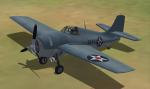
Grumman F4F-3 Wildcat VMF-211, Wake Island December 1941
The original Grumman F4F-1 design was a biplane, which proved inferior to rival designs, necessitating a complete redesign as a monoplane, the F4F-2. This design was still not competitive with the Brewster F2A Buffalo which won initial U.S. Navy orders. Grumman completely rebuilt the prototype as the XF4F-3 with new non-folding wings and tail and a supercharged version of the Pratt & Whitney R-1830 "Twin Wasp" radial engine.Testing of the new XF4F-3 led to an order for F4F-3 production models, the first of which was completed in February 1940. The U.S. Navy officially adopted the aircraft type as the Wildcat. Armed with four .50 in (12.7 mm) Browning machine guns, it joined active units in 1940. At the time of Pearl Harbor, only Enterprise had a fully equipped Wildcat squadron, VF-6. By the end of February, 1942 the US Navy had replaced its Brewster F2A's with the F3F-3 and F3F-3A Wildcats.
The fixed wing F4F-3 Wildcat was generally outperformed by its major opponent the Mitsubishi Zero, but it was more successful in combat partly because, with relatively heavy armor and self-sealing fuel tanks, the Grumman airframe could survive far more damage. In the hands of an expert pilot with a tactical advantage, the Wildcat could prove a difficult opponent even against the formidable Zero. USN Commander "Jimmy" Thach devised a very effective defensive tactic that allowed Wildcat formations to act in a coordinated crossover maneuver to counter a diving attack, called the "Thach Weave".
Credits
Captain Kurt: Aircraft model, drop tank, bomb rack, bomb, VC, paint textures, aircraft flight files, and .dp
Shessi: Pilot figure
Morton: 2D F4F instrument panel modified to an F4F-3 version
Kelticheart: Prop blurred texture
Microsoft: Gauges and .air file
Posted May 7, 2026 15:34 by Captain Kurt
6.39Mb (38 downloads)
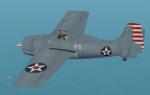
Grumman F4F-3 Wildcat VF-2 USS Lexington (CV2) Lt. Albert O. Vorse Coral Sea May 1942
The original Grumman F4F-1 design was a biplane, which proved inferior to rival designs, necessitating a complete redesign as a monoplane, the F4F-2. This design was still not competitive with the Brewster F2A Buffalo which won initial U.S. Navy orders. Grumman completely rebuilt the prototype as the XF4F-3 with new non-folding wings and tail and a supercharged version of the Pratt & Whitney R-1830 "Twin Wasp" radial engine.Testing of the new XF4F-3 led to an order for F4F-3 production models, the first of which was completed in February 1940. The U.S. Navy officially adopted the aircraft type as the Wildcat. Armed with four .50 in (12.7 mm) Browning machine guns, it joined active units in 1940. At the time of Pearl Harbor, only Enterprise had a fully equipped Wildcat squadron, VF-6. By the end of February, 1942 the US Navy had replaced its Brewster F2A's with the F3F-3 and F3F-3A Wildcats.
The fixed wing F4F-3 Wildcat was generally outperformed by its major opponent the Mitsubishi Zero, but it was more successful in combat partly because, with relatively heavy armor and self-sealing fuel tanks, the Grumman airframe could survive far more damage. In the hands of an expert pilot with a tactical advantage, the Wildcat could prove a difficult opponent even against the formidable Zero. USN Commander "Jimmy" Thach devised a very effective defensive tactic that allowed Wildcat formations to act in a coordinated crossover maneuver to counter a diving attack, called the "Thach Weave".
Credits
Captain Kurt: Aircraft model, drop tank, bomb rack, bomb, VC, paint textures, aircraft flight files, and .dp
Shessi: Pilot figure
Morton: 2D F4F instrument panel modified to an F4F-3 version
Kelticheart: Prop blurred texture
Microsoft: Gauges and .air file
Posted May 7, 2026 15:32 by Captain Kurt
4.14Mb (52 downloads)
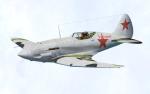
Mikoyan Gurevich Mig-3 late version
Unit: 148 IAP
The late Spanish Civil war experience showed the Soviet fighter aircraft to be inferior to the German Bf 109 which convinced Stalin that the Soviet Air Force needed to develop more modern fighter aircraft. The Mig-1 was one of several types rushed through design and into service in 1939 /1940. Major teething problems were encountered and the type went through several design changes resulting in the Mig-3. The Mig-3 was widely in service when the German invasion began. The late version incorporated a longer nose to accommodate space for more ammunition. Designed as a high altitude interceptor, the Mig-3 was forced to fight at low altitudes and even in ground attacks where it was unsuited and its performance was inferior to German types. Nevertheless it was available in large numbers and continued in service well into 1943.
Credits
Captain Kurt: Aircraft model, and Rs-82 rockets and rack
UncleTgt: Paint schemes and air files
Shessi: Pilot figure
Kelticheart: Prop blurred texture
Posted Apr 23, 2026 18:53 by Captain Kurt and UncleTgt
6.55Mb (33 downloads)
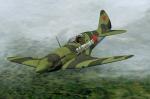
Mikoyan Gurevich Mig-3 late version w/ patriotic slogan Za Rodinu
The late Spanish Civil war experience showed the Soviet fighter aircraft to be inferior to the German Bf 109 which convinced Stalin that the Soviet Air Force needed to develop more modern fighter aircraft. The Mig-1 was one of several types rushed through design and into service in 1939 /1940. Major teething problems were encountered and the type went through several design changes resulting in the Mig-3. The Mig-3 was widely in service when the German invasion began. The late version incorporated a longer nose to accommodate space for more ammunition. Designed as a high altitude interceptor, the Mig-3 was forced to fight at low altitudes and even in ground attacks where it was unsuited and its performance was inferior to German types. Nevertheless it was available in large numbers and continued in service well into 1943.
Credits
Captain Kurt: Aircraft model, and Rs-82 rockets and rack
UncleTgt: Paint schemes and air files
Shessi: Pilot figure
Kelticheart: Prop blurred texture
Posted Apr 23, 2026 18:50 by Captain Kurt and UncleTgt
6.81Mb (28 downloads)
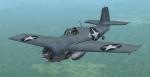
Grumman F4F-4 Wildcat VMF-224, Guadalcanal September, 1942
The Wildcat was the only effective fighter available to the United States Navy and Marine Corps in the Pacific from 1941 to 1943. While the Wildcat was still outperformed by the faster, more maneuverable, and longer ranged Mitsubishi A6M Zero, the F4F's ruggedness combined with effective US pilot's tactics made it more successful in combat. The first operational version, the F4F-3 had a fixed wing which limited the number a fleet aircraft carrier could operate to 18. Grumman had proposed incorporating a folding wing to the Wildcat in 1940 and the Navy had awarded a contract for the F4F-4 in 1941. The folding wings would allow the fleet carriers to operate 27 Wildcats. The Battle of the Coral Sea had proved the need for more fighters for CAP and escort, and the Navy rushed to replace the fixed wing F4F-3 with the new F4F-4 before the next inevitable carrier battle which turned out to be Midway. Navy and Marine pilots weren't thrilled with the F4F-4 as it was heavier, less maneuverable, and had added 2 more machine guns which reduced the ammunition to each and reduced the firing time. But it was what they had. They made the most of it that they could, and held the line through 1943.
Credits
Captain Kurt: Aircraft model, drop tank, bomb rack, bomb, VC, paint textures, aircraft flight files, and .dp
Shessi: Pilot figure
Morton: 2D F4F instrument panel modified to an F4F-3 version
Kelticheart: Prop blurred texture
Microsoft: Gauges and .air file
Posted Apr 17, 2026 17:16 by Captain Kurt
7.06Mb (17 downloads)
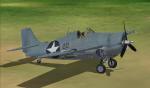
Grumman F4F-4 Wildcat VMF-121, Guadalcanal October, 1942
The Wildcat was the only effective fighter available to the United States Navy and Marine Corps in the Pacific from 1941 to 1943. While the Wildcat was still outperformed by the faster, more maneuverable, and longer ranged Mitsubishi A6M Zero, the F4F's ruggedness combined with effective US pilot's tactics made it more successful in combat. The first operational version, the F4F-3 had a fixed wing which limited the number a fleet aircraft carrier could operate to 18. Grumman had proposed incorporating a folding wing to the Wildcat in 1940 and the Navy had awarded a contract for the F4F-4 in 1941. The folding wings would allow the fleet carriers to operate 27 Wildcats. The Battle of the Coral Sea had proved the need for more fighters for CAP and escort, and the Navy rushed to replace the fixed wing F4F-3 with the new F4F-4 before the next inevitable carrier battle which turned out to be Midway. Navy and Marine pilots weren't thrilled with the F4F-4 as it was heavier, less maneuverable, and had added 2 more machine guns which reduced the ammunition to each and reduced the firing time. But it was what they had. They made the most of it that they could, and held the line through 1943.
Credits
Captain Kurt: Aircraft model, drop tank, bomb rack, bomb, VC, paint textures, aircraft flight files, and .dp
Shessi: Pilot figure
Morton: 2D F4F instrument panel modified to an F4F-3 version
Kelticheart: Prop blurred texture
Microsoft: Gauges and .air file
Posted Apr 17, 2026 17:14 by Captain Kurt