



All Time Popular > Page 5460
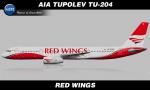
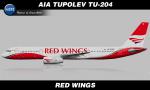
AIA Tupolev Tu-204 Red Wings Textures
(Category: FSX > Payware)
0.78Mb (65 downloads)
FS9/FSX AIA Tupolev Tu-204-100 in Red Wings livery. Texture only for AI Aardvark model. Repaint by Sergey Gleba aka serg09. Link to my products on SimMarket: http://secure.simmarket.com/paintsim.mhtml
Posted Dec 7, 2022 00:46 by Sergey Gleba aka serg09

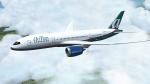
FSX/P3D Quality Wings Boeing 787 AirTran Airways Textures
(Category: FSX > Payware)
18.58Mb (65 downloads)
Airtran Airways(New Livery) textures for the payware Quality Wings 787-8 RR N787AT. Commissioned by Alec Slaby. Created by iniBuilds!
Posted Jan 20, 2020 19:24 by Alec Slaby
PuntoInicioAguaSpain
(Category: Prepar3d > Scenery)
0.20Mb (65 downloads)
As a thank you to this great web I provided 6 starting points in the reservoir of the community of Madrid, Spain
Posted Apr 15, 2019 16:08 by Angel G Beato
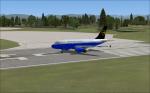
Just Flight A318 Golden Eagle Airways Textures
(Category: FSX > Payware)
1.50Mb (65 downloads)
Golden Eagle Airways (a VA) Textures for the payware Just Flight A318.
Posted Mar 14, 2011 19:53 by Charles Jackson
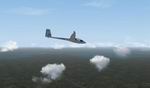
FS2002/2004 Whole Guyanas, South America, Soaring Scenery.
(Category: FS2004 > Gliders and Ultralites)
1.03Mb (65 downloads)
FS2002/2004
Whole Guyanas, South America, Soaring Scenery.
This file adds thermals lifts to glider´s flights over Guyana(England),
French Guyana and Suriname (Holland) Regions, South America.
Design:Francisco Vargas. 1MB
Posted Jun 23, 2008 14:18 by archive
.jpg-thumb.jpg)
.jpg-thumb.jpg)
FSX/FS2004 Pilotable French Frigate L' Etoil du Roy
(Category: FSX > Misc)
7.66Mb (64 downloads)
FSX/FS2004 Pilotable French Frigate L' Etoil du Roy, representing the 18th century. In fact the real vessel is a replica, buildt 1997 in Turkey as Grand Turk and it was mainly used as movie ship for the "Hornblower" TV serie. My model offers animated guns, seperatly for port and starboard. In FSX twenty three camera views provide decks- mast- and external views to watch all the animations. FSDS3.5 model, animations and cameras by Erwin Welker.
Posted Mar 25, 2026 08:31 by Erwin Welker
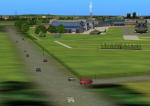
ETHB Bückeburg AB
(Category: FS2004 > Scenery)
42.08Mb (64 downloads)
Bückeburg ETHB is one of the most important helicopter air bases in Germany. Before getting a German helicopter air base it played also an interesting role in the famous Berlin Airlift.
The scenery was done by Freddy Hundertmark. It should published here not to be forgotten as the original link is no longer operational
Posted Feb 27, 2026 14:01 by Michael Vader
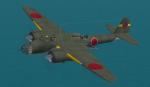
Kawasaki ki.48-II Lily
(Category: CFS2 > Aircraft)
12.81Mb (64 downloads)
Kawasaki Ki48-I Lily (or "Type 99 Light Bomber")
Unit: 208the Light Bomber Air Combat Regiment, 3rd Company, New Guinea, April 1944
Designated a light bomber by the Japanese, the Ki.48 was Japan’s answer to the Russian SB-2 bombers encountered in China, which had proven almost as fast as the Ki-27 "Nates" sent to intercept them. Kawasaki received the specification in December 1937 and a team led by Doi Takeo based the design on lessons learned from the Ki.45 "Nick". The Ki.48 prototype was completed July 1939. After modifications to reduce tail flutter, the first production aircraft began rolling out of the factory in July 1940. "Lily" saw its first operational use in north China, where it encountered almost no fighter opposition.
The Ki.48-I was definitely obsolete by the start of the Pacific War, being slow and lacking adequate defensive armament, armor, and self-sealing fuel tanks.
An improved version, the Ki.48-II, was developed in late 1941. It had more powerful engines using two-stage blowers for better high altitude performance, armor protection to both fuel tanks and crew. Externally, it was almost identical to the earlier Ki.48-I with the only visual difference being the larger air scoop on the cowling top and a smaller air scoop at the cowling bottom.
The prototypes first flew in February 1942. But the improvements were not enough to eliminate its vulnerability to Allied fighters. It nonetheless became the most important Army light bomber in the Southwest Pacific. It was Japan's third most produced bomber and continued in service through the end of the war.
Credits
Captain Kurt: Aircraft model, VC, paint textures, aircraft flight files, and .dp
Wolfi: Crew figures
Allen: Japanese bombs (included in zip file)
Lawdog2360: Sound
Gauges by: ACWai, Mopar Mike, FDG2 and Microsoft
Posted Feb 2, 2026 02:39 by Captain Kurt
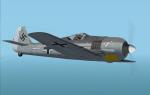
Focke Wulf Fw 190A-3 4JG1
(Category: CFS2 > Aircraft)
5.06Mb (64 downloads)
Focke Wulf Fw 190A-3
Unit: 4./JG1, Woensdrecht, the Netherlands March 1942
Pilot: Oblt. Robert Olejnik
This aircraft had all 4 wing cannons.
The Fw 190 series entered combat with the A-1 model in September 1941 proving a huge shock to the RAF as it was clearly superior to the Spitfire V (which was the primary RAF fighter at the time) in everything except turning radius. However these early versions suffered from severe engine overheating problems and fires which kept serviceability rates low throughout 1941. This was somewhat solved in the field by JG26 technical officers by rerouting the exhaust pipes and opening cooling slots in the fuselage aft of the engine. These changes were introduced into the production line for the following A-2 models which began arriving in December 1941.
The Fw 190 A-3 began deliveries in the spring of 1942 with the change to the more powerful BMW 801D-2 1700hp engine using 96 octane fuel, replacing the unreliable BMW 801C-1 in the Fw190 A-2. Fw 190A-3 was externally identical to the A-2, which makes the two variants extremely difficult to tell apart. The only positive visual clues could only be seen up-close: the C3 fuel triangles and the Werknummer. Like the A-2, it had two cowl mounted MG 17 machine guns, two inboard wing mounted MG 151 20mm cannons with protruding barrels and wing root blisters, plus two MG FF 20mm cannons in outboard positions, with underwing bulges. The slower firing MG FF cannons with its limited 90 rpg were often removed in the field and panel bulges replaced with flat panels.
Besides the difference in the number of wing cannons, the only other major variant was the FW 190A-3/U3 fighter bomber which had an under-fuselage mounted bomb rack ETC 501 for carriage of 500 kg of bombs (1 500 kg, 1 250 kg or 4 50 kg on the ER4 adapter) or an external drop tank of 300 liter capacity for long range fighters. These usually had the retractable small gear cover doors removed which would interfere with the ordinance loads.
By early 1943, 509 A-3s had been built. By mid 1943 it was being relagated to opertional training organizations.
--------------------------------------------------------------------------------------------------------------------------------------------------------------------
Captain Kurt developed the model using some parts of the Design Team Daedalus Fw 190D-9 model, which in turn was developed from the old Pstrany Dora model by Captain Kurt - with permission. The new model added multiple details, new parts, new VC, and animations. The air files are a further development of the Design Team Daedalus FW 190 series.
Captain Kurt also created the camouflage paints, and the 2D instrument panel.
Keticheart: prop blur .bmp
AliCat: o2 Wachter and Sauerstoff guages
FSD: most of the gauges
other gauge authors are unknown
Posted Jan 12, 2026 16:22 by Captain Kurt
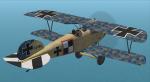
Albatros D.III (OAW)
(Category: CFS2 > Aircraft)
4.01Mb (64 downloads)
The Albatros D.III (OAW)
The Albatros D.III was a development of the Albatros D.II. Having investigated the construction of captured Nieuport fighters, Albatros engineers designed the lower wing of the D.III narrower and shorter than the upper, supported by V-shaped struts. The Mercedes 6 cylinder engine was increased to 180hp from 160hp. Wing tips became swept, that helped to avoid wings vibration. The aileron control rods were drawn through the lower wing, and the radiator was displaced from the fuselage side to the middle of the upper wing. Weight reduction was one of the main objectives at that time.
Test flights began in August – September of 1916, and in December 1916 the plane was delivered to fighter squadrons. Several months of combat flights revealed that plane could lose its lower wing in a steep dive or in a sharp turn. Water from radiator, placed on the upper wing, poured out onto the machineguns making firing impossible. After this, radiator was placed to the right side of the pilot. By June 1917 Albatros started using new Daimler’s cellular radiator that helped to solve problem with engine overheating.
The plane was manufactured in Albatros Werke and Ostdeutsche Albatros Werke (OAW) factories. The OAW version is principally identified by the use of a rounded rudder, which later became standard on the later D.V series. In total 1346 copies of Albatros D.III were built.
---------------------------------------------------------------------------------------------------------------
The model, textures. panel and air files are by Captain Kurt. The pilot figures were developed from Wolfi's freeware Japanese pilot .fsc source file. The prop spinning texture is by Kelticheart.
Gauges are by Martin Klein with texture change outs by Captain Kurt
Posted Nov 18, 2025 22:20 by Captain Kurt