



All Time Popular > Page 5520

Phönix D.1
(Category: CFS2 > Aircraft)
6.03Mb (44 downloads)
Phönix D.I / D.II
The Phönix D.I biplane was intended as a replacement for the Hansa-Brandenburg D. I. It was produced in smaller numbers (120 D. I, 45 D. II, and 48 D. IIa fighters) than the Hansa-Brandenburg. The Phönix D.I began production in August 1917 and the D.II replaced the D.I in production in March 1918 . The Phönix D-series fighters are generally considered the best fighters designed and produced in Austria-Hungary.
Previously, the Phönix Flugzeug-Werke firm had been contracted to produce the Hansa-Brandenburg D.I fighter under license. It became apparent by 1917 that the infamous Star-strutter could not be developed further, and the company embarked on a new aircraft. The design eventually incorporated a fuselage similar to the D.I and also sported wings of unequal span that ended in rounded wingtips. It was also considerably more powerful, with a Hiero 200- horsepower engine. It located the machine guns within the engine cowling which enhanced streamlining but placed the guns beyond the pilot’s reach if they jammed. The resulting craft was faster in level flight but somewhat unstable and slow-climbing. In December 1917 it entered service as the Phönix D.I and was deployed with army and navy units. The new machine was far from perfect, but it represented a dramatic improvement over the earlier Star-strutter, proving to be a match for Allied fighters.The model, textures. panel and air files are by Captain Kurt. The pilot figures were developed from Wolfi's freeware Japanese pilot .fsc source file. The prop spinning texture is by Kelticheart.
Gauges are by Martin Klein with texture change outs by Captain Kurt
Posted Dec 15, 2025 17:05 by Captain Kurt

Ant's Tiger Moth Pro G-AOIS Textures
(Category: FSX > Payware)
52.09Mb (44 downloads)
G-AOIS livery for Ant's Tiger Moth Pro FSX.
Posted Oct 3, 2022 10:33 by Dave T


Maddog MD-83 - British Island Airlines Textures
(Category: Prepar3d > Payware)
21.16Mb (44 downloads)
P3D V4+ LSH Maddog MD-83 in British Island Airlines - BIA livery. Texture only for payware Maddog model. Repaint by Sergey Gleba aka serg09. Link to my products on SimMarket: http://secure.simmarket.com/paintsim.mhtml
Posted Nov 10, 2020 12:40 by Sergey Gleba aka serg09

CFS2
- Instrument panel for Arado Ar-234
(Category: CFS2 > Panels)
(44 downloads)
CFS2
- Instrument panel for Arado Ar-234 by:LOBO
DA SILVA. 685K
Posted Jun 10, 2008 11:30 by archive
The
56th Fighter Group
(Category: CFS1 > Missions & Campaigns)
(44 downloads)
The
56th Fighter Group
- Zemke's Wolfpack Join the famous 56th in this historically accurate
6 mission USAAF Campaign. Uses CFS default aircraft & scenery. Author
Bill Potvin. 55K
Posted Jun 10, 2008 11:32 by archive
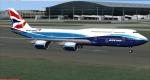
FSX/P3D/FS2004 Boeing 747-8I British Airways Boeing Textures
(Category: FSX > Civil Jets)
11.89Mb (43 downloads)
Fictional repaints of British Airways "Boeing" livery for SkySpirit2012 Boeing 747-8I Genx model. Repainted by Toby Boult. Texture only. Requires a full package Skyspirit 747-8i Genx model.
Posted Oct 11, 2026 09:29 by Toby Boult
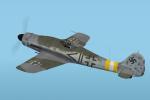
Focke Wulf Fw 190D-9 early canopy Stab IJG 2
(Category: CFS2 > Aircraft)
10.49Mb (43 downloads)
Focke Wulf Fw 190D-9 early canopy
by Design Team Daedalus
Unit: Stab I./JG 2 Bodenplatte operation, Dorff, Germany January 1, 1945
Pilot: Fw. Werner Hohenburg
The Fw 190D-9 combined the Fw 190A-8 fuselage and wings with the Jumo 213A-1 engine to create a higher altitude capable fighter than the A-8. The first production aircraft were completed at Focke-Wulf’s factory at Sorau in Silesia in late August 1944. Problems with engine meant that the second aircraft wasn’t completed until mid-September, but construction soon sped up. By the end of September production was underway at Focke-Wulf’s factory at Cottbus, and in October work began at Roland (WFG) at Nordenahm and Fieseler at Kassel. Junkers and Siebel produced parts, and Arado was also involved in the program. The total number produced is unclear, with at least 670 known and no records for December 1944 or February 1945 to the end of the war. 1,500 serial numbers are known to have been allocated to the D-9, but that doesn’t mean that all of these aircraft were completed.
The standard D-9 was armed with two 13mm MG 131 machine guns above the engine and two 20mm MG 151 cannon in the wing roots. It could also carry an ETC 501 or ETC 504 stores carriers below the fuselage.
The first D-9 unit, III./JG 54, began to convert to the type in September 1944, and by the end of October had 68 aircraft, of which only one had the MW 50 installed. However 53 had been given a new Junkers kit that increased the manifold pressure in the engine and boosted power from 1,750hp to around 1,870hp.
By the end of December 1944 there were 183 D-9s in service with three units (III./JG 54, II./JG 26 and III./JG 26), with some equipped with both the MW 50 and Junkers kits, some with one or the other and some without either. However new aircraft coming off the production line mainly had both.
Early in 1945 the D-9 was issued to JG 2, JG 3, JG 6, JG 51 and JG 301, although these units normally operated a mix of types. In service the D-9 was considered to be as good as its main opponents, in particular the Merlin powered P-51 Mustangs and the Griffon powered Spitfire Mk.XIV. It handled better than the Fw 190A, was faster and climbed quicker. It could out-turn most Soviet fighters at the normal combat levels, and was quicker in the dive than the Yak-3 or Yak-9.
It was a very good fighter for that time but was too little too late to have any effect on the course of the war.
--------------------------------------------------------------------------------------------------------------------------------------------------------------------
Captain Kurt developed the model from the old Pstrany Dora model - with permission - as a starting framework and updated the shape, and added multiple details, new parts, new VC, and animations. The original Pstrany airfiles, and Dora weapons models for the drop tanks, weapons, and racks are still used as is the Jumo sound package (included)
Model revision 3 fixes an animation error and several minor model improvements
Captain Kurt also created the camouflage paint, and the 2D instrument panel.
Posted Jan 17, 2026 09:44 by Design Team Daedalus
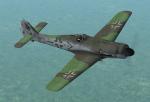
Focke Wulf Fw 190D-9 early canopy Stab IIJG 6
(Category: CFS2 > Aircraft)
10.13Mb (43 downloads)
Focke Wulf Fw 190D-9 early canopy
by Design Team Daedalus
Unit: Stab II./JG 6 Airbase Ruzyne, Prague, Czechoslovakia May, 1945
Pilot: unknown
The Fw 190D-9 combined the Fw 190A-8 fuselage and wings with the Jumo 213A-1 engine to create a higher altitude capable fighter than the A-8. The first production aircraft were completed at Focke-Wulf’s factory at Sorau in Silesia in late August 1944. Problems with engine meant that the second aircraft wasn’t completed until mid-September, but construction soon sped up. By the end of September production was underway at Focke-Wulf’s factory at Cottbus, and in October work began at Roland (WFG) at Nordenahm and Fieseler at Kassel. Junkers and Siebel produced parts, and Arado was also involved in the program. The total number produced is unclear, with at least 670 known and no records for December 1944 or February 1945 to the end of the war. 1,500 serial numbers are known to have been allocated to the D-9, but that doesn’t mean that all of these aircraft were completed.
The standard D-9 was armed with two 13mm MG 131 machine guns above the engine and two 20mm MG 151 cannon in the wing roots. It could also carry an ETC 501 or ETC 504 stores carriers below the fuselage.
TThe first D-9 unit, III./JG 54, began to convert to the type in September 1944, and by the end of October had 68 aircraft, of which only one had the MW 50 installed. However 53 had been given a new Junkers kit that increased the manifold pressure in the engine and boosted power from 1,750hp to around 1,870hp.
By the end of December 1944 there were 183 D-9s in service with three units (III./JG 54, II./JG 26 and III./JG 26), with some equipped with both the MW 50 and Junkers kits, some with one or the other and some without either. However new aircraft coming off the production line mainly had both.
Early in 1945 the D-9 was issued to JG 2, JG 3, JG 6, JG 51 and JG 301, although these units normally operated a mix of types. In service the D-9 was considered to be as good as its main opponents, in particular the Merlin powered P-51 Mustangs and the Griffon powered Spitfire Mk.XIV. It handled better than the Fw 190A, was faster and climbed quicker. It could out-turn most Soviet fighters at the normal combat levels, and was quicker in the dive than the Yak-3 or Yak-9.
It was a very good fighter for that time but was too little too late to have any effect on the course of the war.
--------------------------------------------------------------------------------------------------------------------------------------------------------------------
Captain Kurt developed the model from the old Pstrany Dora model - with permission - as a starting framework and updated the shape, and added multiple details, new parts, new VC, and animations. The original Pstrany airfiles, and Dora weapons models for the drop tanks, weapons, and racks are still used as is the Jumo sound package (included)
Model revision 3 fixes an animation error and several minor model improvements
Captain Kurt also created the camouflage paint, and the 2D instrument panel.
Posted Jan 17, 2026 15:39 by Design Team Daedalus

Bf109E-1_7.JG54
(Category: CFS2 > Aircraft)
8.35Mb (43 downloads)
Messerschmitt Bf 109E-1
by Design Team Daedalus
Unit: 7./JG54 October 27 1940 crash landed at Lydd, England.
Pilot: Fw. Artur Beese
To improve on the performance afforded by the 690 hp Jumo 210 of the earlier Bf 109 versions, the larger, longer 1080 hp Daimler-Benz DB 601A engine was used. As a consequence, the nose, cooling system, and wings had to be redesigned resulting in the classic Bf 109 series. In late 1938, the Bf 109E entered production. It entered general service with the Luftwaffe in the spring of 1939. A total of 1,183 E-1 were built, 110 of them were E-1/B fighter bomber versions.
There were many small differences between individual E-1s because the E-1 was often modified in the field by groundcrew and rear area repair depots. The production standard was lightly armed with two 7.92mm MG17s above the engine and two in the wings and had no pilot armor. Mods included types of pilot head armor,E-4 type squared canopies, E-7 type pointed spinners, etc., but changing the wing MG17 armament required new different wings.
So each model we have created has its own unique features. This aircraft had a flat plate with a curved top pilot head armor retrofitted.
By the time the later Bf 109E-4 and Bf 109E-7 marks were equipping the Jagdgeschwaders a program was initiated to withdraw and remanufacture the surviving E-1s to either full E-4 or E-7 standard.
Pstrany is the primary model author with some small model refinement and additions by Captain Kurt as the model was collaborated on during development. Captain Kurt created the textures for each, the 2D instrument panel, the individual .dp files, air files and aircraft.cfg files.
Posted Oct 12, 2025 16:14 by Design Team Daedalus
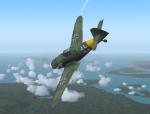
Bf109G-10 5.JG11
(Category: CFS2 > Aircraft)
12.14Mb (43 downloads)
Messerschmitt Bf109G-10 Erla built
by Design Team Daedalus
Unit: 5./JG11 - surrendered at Rechlin-Lärz, Germany May 7, 1945
Pilot: Unknown
The Bf109G-10 was an attempt by the RLM to standardize the Bf109 sub-types using the new DB 605D engine fitted with MW-50 (methanol water 50/50 mix) boost giving an increase to 1775hp.
However this attempt was a massive failure and there is no "standard" Bf 109G-10. The only consistent features were the use of the "Erla Haube" canopy and a version of the DB 605D engine requiring a streamlined cowling to cover the larger engine configuration.
The Erla factory used a completely different engine cowling type with the port side featuring a rectangular fairing behind the engine and an ellipse shape on the starboard side. The WNF and Regensburg plants used an ellipse shape on both sides and had small chin bulges. Regensburg production seems to have been mostly conversions of existing G6 and G-14 airframes.
Most used larger main wheels which required the larger rectangular shaped upper wing fairings, but some used the smaller wheels with the smaller teardrop shaped upper wing fairings. While all had the tall horizontal tail type, they used different rudder types. Different types of oil coolers, tail wheel struts, antenna masts, etc. from subcontractors were available at different times during the production runs.
Armament was different too. Most WNF built G-10s were the G-10/U4 subtype using a 30mm cannon in the nose rather than the 20mm used in the Erla and Regensburg built models.
Given the many different features that existed on individual G-10 aircraft, each model we have created has its own unique features.
Pstrany began the development of the models using Paul Rebuffat's Messerschmitt model - with permission - as a starting framework and updated the shape, and added a plethora of details, new parts, and ideas. Pstrany also developed the models for the drop tanks, weapons and racks.
Captain Kurt created paints for each, the 2D instrument panel, the .dp files, the air files and the aircraft.cfg files.
Mav SCASM edited each model so that they have animated wing slats, drop tanks, and other features, as well as optimizing models for the best possible frame rates. Mav also developed the idea for the 2d panel to be offset for the Revi gun sight to match the CFS2 reticle.
Posted Oct 4, 2025 17:33 by Design Team Daedalus