



All Time Popular > Page 5530
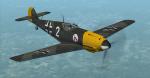
Bf109E-1_4.JG52
(Category: CFS2 > Aircraft)
8.02Mb (28 downloads)
Messerschmitt Bf 109E-1
by Design Team Daedalus
Unit: 2./JG77 August 1939 Juliusburg, Germany and during the Polish campaign September - October
Pilot: Hptm. Johannes Trautloft
To improve on the performance afforded by the 690 hp Jumo 210 of the earlier Bf 109 versions, the larger, longer 1080 hp Daimler-Benz DB 601A engine was used. As a consequence, the nose, cooling system, and wings had to be redesigned resulting in the classic Bf 109 series. In late 1938, the Bf 109E entered production. It entered general service with the Luftwaffe in the spring of 1939. A total of 1,183 E-1 were built, 110 of them were E-1/B fighter bomber versions.
There were many small differences between individual E-1s because the E-1 was often modified in the field by groundcrew and rear area repair depots. The production standard was lightly armed with two 7.92mm MG17s above the engine and two in the wings and had no pilot armor. Mods included types of pilot head armor,E-4 type squared canopies, E-7 type pointed spinners, etc., but changing the wing MG17 armament required new different wings.
So each model we have created has its own unique features. This aircraft sports the oldest camouflage scheme used on the E-1.
By the time the later Bf 109E-4 and Bf 109E-7 marks were equipping the Jagdgeschwaders a program was initiated to withdraw and remanufacture the surviving E-1s to either full E-4 or E-7 standard.
Pstrany is the primary model author with some small model refinement and additions by Captain Kurt as the model was collaborated on during development. Captain Kurt created the textures for each, the 2D instrument panel, the individual .dp files, air files and aircraft.cfg files.
Posted Oct 12, 2025 16:11 by Design Team Daedalus

Bf109G-2_2.LeLV_34
(Category: CFS2 > Aircraft)
11.26Mb (28 downloads)
Messerschmitt Bf109G-2
by Design Team Daedalus
Unit: 2/LeLV 34 Finland, March 1943
Pilot: Kapt. K. Lahtela
During the summer of 1941, the Messerschmitt design team was engaged in updating the BF 109F-4 as the dictates of the air war was forcing the need for greater speeds. The result was the Gustav series, of which the first substantial production run was the Bf 109G-2. Adopting the more powerful but heavier Mercedes Benz DB 605 engine required airframe and landing gear strengthening which also added weight. But it was felt the increase in speed made the loss of some maneuverability acceptable. The fuel filler access was moved to the spine behind the cockpit. No change was required for the cowling shape but a deeper oil cooler was needed. The broad blade of the F4/Z was made standard. The lower quarter cockpit window panel was deleted and vent scoops could be added to the new replacement metal panel. The wheel wells reverted to a squared end in anticipation of wheel covers that in the event were not adopted. Generally speaking the appearance of the G-2 was very similar to the F-4 without close examination. Deliveries of the G-2 began in May 1942 with 1,587 produced by February 1943.
However, there is no "standard" Bf 109G-2. Although production only ran 10 months before the G-3 and G-4 were introduced, three separate companies and multiple sub-assembly production facilities were involved which inevitably produced minor variations, such as pilot head armor type, cockpit vents and tail wheel types. So each model we have created has its own unique features to portray the specific aircraft presented as accurately as possible.
This aircraft was one of 48 G-2s supplied to Finland. It had a cockpit vent on the starboard side only, a 2 piece curved top pilot head armor, and a non-retractable tail wheel.
Pstrany developed the models using Paul Rebuffat's Messerschmitt model - with permission - as a starting framework and updated the shape, and added a plethora of details, new parts, and ideas. Pstrany also developed the models for the drop tanks, weapons and racks.
Captain Kurt created paints for each, the 2D instrument panel, the individual .dp files, the air files and the aircraft.cfg files.
Mav SCASM edited each model so that they have animated wing slats, drop tanks, and other features, as well as optimizing models for the best possible framerates. Mav also developed the idea for the 2d panel to be offset for the Revi gunsight to match the CFS2 reticle.
Posted Oct 4, 2025 21:46 by Design Team Daedalus
FS98 Meigs Field Soaring Scenery
(Category: FS98 > Gliders and Ultralites)
0.00Mb (28 downloads)
FS98
Meigs Field Soaring Scenery This file add some thermals
to default Chicago Merril C. Meigs scenery. It is freeware.
By Francisco Vargas. 2K
Posted Jun 23, 2008 14:18 by archive
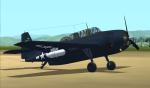
WF/CK TBM-3E Avenger VMTB232
(Category: CFS2 > Aircraft)
8.67Mb (27 downloads)
General Motors TBM-3E Avenger
Unit: VMTB-232 "The Red Devils" Okinawa invasion, April, 1945
After the Battle of Midway which was disastrous for the TBD Devastator torpedo squadrons, the Grumman Avenger became the standard torpedo bomber for the US Navy. With orders for the Grumman TBF Avenger outstripping Grumman's production capacity, the decision was taken for General Motors to produce the aircraft. These would be known as TBM Avengers.
While Grumman had attempted to continue development of their TBF Avenger, it would be General Motors who would do so as they produced the TBM-3 which was powered by the more powerful 1,900-hp Wright R-2600-20 engine. This required a redesign of the cowling to have more, larger cowl flaps, and double cooling intakes (with upper and bottom inlets). Additionally, the TBM-3 featured strengthened wings to allow for more types of ordnance to be fitted.
General Motors Eastern Aircraft Division began series production of the TBM-3 Avengers in the middle of 1944. It became the standard USN torpedo bomber in the last year of WWII.
Further TBM-3 development by General Motors proceeded for radar capabilities. The E designation would simply mean the addition of electronic equipment, in this case provisions for carrying the APS-4 radar on a stores pylon under the right wing. This also coincided with a program by Eastern to reduce weight by about four hundred pounds. The changes included the location of the tail hook, which had been internally housed on all TBFs and prior TBM production to an external tail hook, deletion of tunnel gun postion, and some armor, etc.
The TBM-3 Avenger had a top speed of 267 mph, range of 1,130 miles with a service ceiling of 23,400 ft. Armament was three 0.50-in machine-guns and one 0.30-in machine-gun. Bomb load was either 2,000lb bombs, depth charges or torpedoes. Rocket projectiles could also be carried. The TBM-3 Avenger had a top speed of 267 mph, range of 1,130 miles with a service ceiling of 23,400 ft. Armament was three 0.50-in machine-guns and one 0.30-in machine-gun. Bomb load was either 2,000lb bombs, depth charges or torpedoes. Rocket projectiles could also be carried.
Credits
With Wolfi's permission, he allowed me to use his TBF-1C model to make the element changes for a TBM-3 model
Wolfi: about 90% of the overall aircraft model
Captain Kurt: TBM-3 model elements, 2D panel. paint textures, and .dp
Kelticheart: Prop blurred texture
Gauges: AAF_Gauges.gau by Scott Jelinek, Military_RMI.gau is a FS98 gauge by 1999 Melville Consulting, the others by Microsoft or authors unknown.
Weapons: Alternate rocket rail Mk4 is originally by Bismarck13 modified by Captain Kurt to fit the TBF, db_us_wep_v2a package is by DBolt, and Depth Charges package is by Baldy
Posted Nov 3, 2026 15:07 by Captain Kurt
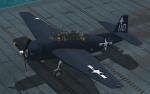
WF/CK TBM-3 Avenger VT82
(Category: CFS2 > Aircraft)
8.88Mb (27 downloads)
General Motors TBM-3 Avenger
Unit: VT-82 USS Bennington February 1945
After the Battle of Midway which was disastrous for the TBD Devastator torpedo squadrons, the Grumman Avenger became the standard torpedo bomber for the US Navy. With orders for the Grumman TBF Avenger outstripping Grumman's production capacity, the decision was taken for General Motors to produce the aircraft. These would be known as TBM Avengers.
While Grumman had attempted to continue development of their TBF Avenger, it would be General Motors who would do so as they produced the TBM-3 which was powered by the more powerful 1,900-hp Wright R-2600-20 engine. This required a redesign of the cowling to have more, larger cowl flaps, and double cooling intakes (with upper and bottom inlets). Additionally, the TBM-3 featured strengthened wings to allow for more types of ordnance to be fitted.
General Motors Eastern Aircraft Division began series production of the TBM-3 Avengers in the middle of 1944. It became the standard USN torpedo bomber in the last year of WWII.
The TBM-3 Avenger had a top speed of 267 mph, range of 1,130 miles with a service ceiling of 23,400 ft. Armament was three 0.50-in machine-guns and one 0.30-in machine-gun. Bomb load was either 2,000lb bombs, depth charges or torpedoes. Rocket projectiles could also be carried. The TBM-3 Avenger had a top speed of 267 mph, range of 1,130 miles with a service ceiling of 23,400 ft. Armament was three 0.50-in machine-guns and one 0.30-in machine-gun. Bomb load was either 2,000lb bombs, depth charges or torpedoes. Rocket projectiles could also be carried.
Credits
With Wolfi's permission, he allowed me to use his TBF-1C model to make the element changes for a TBM-3 model
Wolfi: about 90% of the overall aircraft model
Captain Kurt: TBM-3 model elements, 2D panel. paint textures, and .dp
Kelticheart: Prop blurred texture
Gauges: AAF_Gauges.gau by Scott Jelinek, Military_RMI.gau is a FS98 gauge by 1999 Melville Consulting, the others by Microsoft or authors unknown.
Weapons: Alternate rocket rail Mk4 is originally by Bismarck13 modified by Captain Kurt to fit the TBF, db_us_wep_v2a package is by DBolt, and Depth Charges package is by Baldy
Posted Nov 3, 2026 15:04 by Captain Kurt
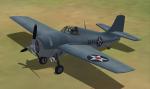
F4F-3 Wildcat VMF-211
(Category: CFS2 > Aircraft)
8.70Mb (27 downloads)
Grumman F4F-3 Wildcat VMF-211, Wake Island December 1941
The original Grumman F4F-1 design was a biplane, which proved inferior to rival designs, necessitating a complete redesign as a monoplane, the F4F-2. This design was still not competitive with the Brewster F2A Buffalo which won initial U.S. Navy orders. Grumman completely rebuilt the prototype as the XF4F-3 with new non-folding wings and tail and a supercharged version of the Pratt & Whitney R-1830 "Twin Wasp" radial engine.Testing of the new XF4F-3 led to an order for F4F-3 production models, the first of which was completed in February 1940. The U.S. Navy officially adopted the aircraft type as the Wildcat. Armed with four .50 in (12.7 mm) Browning machine guns, it joined active units in 1940. At the time of Pearl Harbor, only Enterprise had a fully equipped Wildcat squadron, VF-6. By the end of February, 1942 the US Navy had replaced its Brewster F2A's with the F3F-3 and F3F-3A Wildcats.
The fixed wing F4F-3 Wildcat was generally outperformed by its major opponent the Mitsubishi Zero, but it was more successful in combat partly because, with relatively heavy armor and self-sealing fuel tanks, the Grumman airframe could survive far more damage. In the hands of an expert pilot with a tactical advantage, the Wildcat could prove a difficult opponent even against the formidable Zero. USN Commander "Jimmy" Thach devised a very effective defensive tactic that allowed Wildcat formations to act in a coordinated crossover maneuver to counter a diving attack, called the "Thach Weave".
Credits
Captain Kurt: Aircraft model, drop tank, bomb rack, bomb, VC, paint textures, aircraft flight files, and .dp
Shessi: Pilot figure
Morton: 2D F4F instrument panel modified to an F4F-3 version
Kelticheart: Prop blurred texture
Microsoft: Gauges and .air file
Posted May 7, 2026 15:34 by Captain Kurt
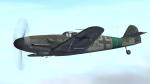
Bf109K-4_12.JG27
(Category: CFS2 > Aircraft)
12.86Mb (27 downloads)
Messerschmitt Bf 190K-4
unit: 12./JG27
pilot: unknown
The Bf 109 Kurfürst was evolved from the Bf 109G-10. The K series was a response to the fact that the bewildering array of series, models, modification kits and factory conversions for the various Bf 109G versions led to logistic problems, making production and maintenance complicated and costly - something Germany could ill-afford late in the war. As such, the RLM (German Aviation Ministry) ordered Messerschmitt to rationalize production of the Bf 109, consolidating parts, types etc to produce a uniform, standard model with better interchangeability of parts and equipment.The "Kurfürst" version was the last and most powerful series of the Bf 109, with only the Bf 109 K-4 being built in large large numbers.
Important features of the "Kurfürst" were the DB 605 DM engine, which was powered by the DB 603's large supercharger. The armament was the MK 108 cannon firing through the propeller hub and a pair of MG 131 machine guns in the upper cowling. The main landing gear had small gear doors covering the retracted wheels fitted in addition to main gear doors, and the tail wheel was also fully retractable with covering doors. Larger wheels measuring 660x190 on 13" rims were used so that the machine could carry the higher flying weight. The retracted larger wheels required rectangular bulges on the wing tops to clear the wheels.
The antenna mast was mostly no longer used at the factory to reduce air resistance and make parachuting safer for the pilot. The DF antenna of the FuG 16 ZY on the back of the fuselage was moved further back to fuselage part 3. The radio access cover, which was previously always in fuselage part 5, was moved forward to fuselage part 4 because of modified installations.
As with other BF 109 versions, there were were variations between individual planes due to dispersed manufacturing and parts shortages forced by Allied bombing.
This aircraft had the small main gear doors removed, a fuselage mounted antenna wire, and a fixed tail wheel gear.
-------------------------------------------------------------------------------------------------------------------------------
Pstrany and Captain Kurt developed the models using Paul Rebuffat's Messerschmitt model - with permission - as a starting framework and updated the shape, and added a plethora of details, new parts, and ideas. Pstrany also developed the models for the drop tanks, weapons and racks.
Captain Kurt created paints for each, the 2D instrument panel, the individual .dp files, the air files and the aircraft.cfg files.
Mav developed the idea for the 2d panel to be offset for the Revi gunsight to match the CFS2 reticle.
Posted Oct 9, 2025 01:54 by Design Team Daedalus


FSLabs A320-SL (SX-GNA) SKY Express Textures
(Category: Prepar3d > Payware)
24.72Mb (27 downloads)
SKY Express A320-SL (SX-GNA), textures for FSLabs Airbus A320-SL (P3D)
Posted Apr 13, 2023 04:43 by Sebastian Gutmann


FAIB Airbus A321 Nordwind - Nordwind VQ-BRL Textures
(Category: FSX > Payware)
0.93Mb (27 downloads)
FS9/FSX FAIB Airbus A321 IAE in Nordwind Airlines new colors livery. Texture only for AI-traffic FAIB model. Repaint by Sergey Gleba aka serg09. Link to my products on SimMarket: http://secure.simmarket.com/paintsim.mhtml
Posted Apr 20, 2021 14:37 by Sergey Gleba aka serg09

Abacus AS 565 Polizei Baden-Württemberg Bussard 1 + 2 Photoreal Textures
(Category: FS2004 > Payware)
2.02Mb (27 downloads)
Bussard 1 + 2 Photoreal Textures only for the payware Abacus AS 565 Panther
Posted Mar 27, 2011 16:09 by benimix - Benedikt Fröhlich