



All Time Popular > Page 5504
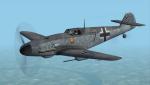
Bf109G-4R6_2JG3
(Category: CFS2 > Aircraft)
11.77Mb (9 downloads)
Messerschmitt Bf109G-4/R6
by Design Team Daedalus
Unit: 2./JG3 Monchen-Gladbach, Germany May 1943
Pilot: Oblt. Detlef Rohwer
The Bf 109G-4 was an incremental development of the G-2. The 1475hp DB605A engine and armament was unchanged from the G-2. The tire size increased from the previous 650 x 150 size to 660 x 160 to better handle the increasing weight of the G series. It still used the spoked wheel rims carried over from the G-2 series but the increased tire size required kidney shaped bulges to be added to the top of the wings above the wheel wells. A larger 350 x 135 tail wheel replaced the earlier 290 x 110 size. Because the larger tail wheel would not fit in the tail wheel recess, the retraction mechanism was disconnected and the tail wheel was fixed in the down position. The radio was replaced with the more powerful FuG 16Z.
It was produced from September 1942 to May 1942:
G-4 production = 727
G-4/trop production = 435
G-4/R3 (reconnaissance) = 80
Still, there was no “standard” G-4. Three separate companies and multiple sub-assembly production facilities were involved which inevitably produced minor variations, such as pilot head armor type, cockpit vents, tail wheel types and field added Rustsatze kits. So, each model we have created has its own unique features to portray the specific aircraft as accurately as possible.
This plane was one of a great many G-4s that were equipped with the R6 Rustsatze 2x 151/20 20mm under wing gondolas as it became apparent the standard single 20mm cannon and 2x 7.92 cowl machine guns armament was inadequate to deal with their opponents. It had a flat plate pilot head armor, no cockpit vents, and the fixed tail wheel gear had no boot.
Pstrany developed the models using Paul Rebuffat's Messerschmitt model - with permission - as a starting framework and updated the shape, and added a plethora of details, new parts, and ideas. Pstrany also developed the models for the drop tanks, weapons and racks.
Captain Kurt created paints for each, the 2D instrument panel, the individual .dp files, the air files and the aircraft.cfg files.
Mav SCASM edited each model so that they have animated wing slats, drop tanks, and other features, as well as optimizing models for the best possible frame rates. Mav also developed the idea for the 2d panel to be offset for the Revi gun sight to match the CFS2 reticle.
Posted Oct 4, 2025 17:04 by Design Team Daedalus
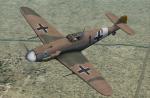
Bf109G-4_trop_R6_8JG53
(Category: CFS2 > Aircraft)
12.09Mb (9 downloads)
Messerschmitt Bf109G-4/Trop R6
by Design Team Daedalus
Unit: 8./JG53
Pilot:
The Bf 109G-4 was an incremental development of the G-2. The 1475hp DB605A engine and armament was unchanged from the G-2. The tire size increased from the previous 650 x 150 size to 660 x 160 to better handle the increasing weight of the G series. It still used the spoked wheel rims carried over from the G-2 series but the increased tire size required kidney shaped bulges to be added to the top of the wings above the wheel wells. A larger 350 x 135 tail wheel replaced the earlier 290 x 110 size. Because the larger tail wheel would not fit in the tail wheel recess, the retraction mechanism was disconnected and the tail wheel was fixed in the down position. The radio was replaced with the more powerful FuG 16Z.
It was produced from September 1942 to May 1942:
G-4 production = 727
G-4/trop production = 435
G-4/R3 (reconnaissance) = 80
Still, there was no “standard” G-4. Three separate companies and multiple sub-assembly production facilities were involved which inevitably produced minor variations, such as pilot head armor type, cockpit vents, tail wheel types and field added Rustsatze kits. So, each model we have created has its own unique features to portray the specific aircraft as accurately as possible.
This aircraft was tropicalized with a supercharger sand filter, umbrella holder fixtures, cockpit vents on both sides, the tail wheel gear had no boot, and the tail wheel bay was open. It was unique in having a so called Galland head armor that became standard on the later G-5/G-6 marks. It was equipped with a Rustsatze R6 pair of 20mm under wing gondola cannons.
Pstrany developed the models using Paul Rebuffat's Messerschmitt model - with permission - as a starting framework and updated the shape, and added a plethora of details, new parts, and ideas. Pstrany also developed the models for the drop tanks, weapons and racks.
Captain Kurt created paints for each, the 2D instrument panel, the individual .dp files, the air files and the aircraft.cfg files.
Mav SCASM edited each model so that they have animated wing slats, drop tanks, and other features, as well as optimizing models for the best possible frame rates. Mav also developed the idea for the 2d panel to be offset for the Revi gun sight to match the CFS2 reticle.
Posted Oct 4, 2025 16:53 by Design Team Daedalus
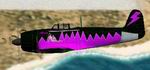
Athena
Corsair repaint.
(Category: CFS2 > Aircraft)
(9 downloads)
Athena
Corsair repaint.
This Aircraft is Dedicated to "Athena" of the 341st Sqn, known in
the CFS2 Games for her honesty and dedication to the game as well
as her positive attitude in both Vitories & Losses she just loves
the game. Her favorite plane is the Nik2-J "George" although she is
much more deadly in an A6M2, I decided to do this Re-paint in her
honor. A Big ~S~ To You Athena Robert (Falcon) Heun. 1.6MB
Posted Aug 24, 2009 06:46 by archive

Bf109T-2 2.JG77
(Category: CFS2 > Aircraft)
8.68Mb (8 downloads)
Messerschmitt Bf 109T-2
by Design Team Daedalus
Unit: 2./JG77 Lister, Norway 1941
Pilot: unknown
The Bf 109T was based on the E-7 and designed as an aircraft carrier fighter intended to serve on Germany's then under construction carrier, the Graf Zeppelin. The wing span was increased to 36 feet, 4.22 inches, a small spoiler was added to the top of the wings, and added an arrestor hook and catapult fittings.
An order for 70 was placed with Fieseler with construction fully underway in April 1941. When construction of the Graf Zeppelin was cancelled, the remaining 63 of 70 T-1s were built as T-2s with the carrier equipment either removed, or inactivated like the wing top spoilers. Some of the T-1s may have been converted to T-2 standard.
It was found that the flight performance of the T-2 was closely comparable to the E-4/N. Because of its ability to take off and land in shorter distances, 42 T-2s were assigned to I/JG.77 and 21 T-2s were assigned to Jagdgruppe Drondheim in June 1941, both units being deployed in Norway on landing strips which were both short and subject to frequent, powerful cross-winds.
In April and May 1943 a few remaining T-2s were operational with 12 assigned to Jagdstaffel Helgoland (subordinated to JG 11) and 10 were with JG300 as night fighters. a few others were scattered around with training units.
With a production run of only 70 units the planes were fairly standardized, but field modifications did exist on some planes.
So each model we have created has its own unique features. This aircraft was equipped with a flat plate plus curved top pilot head armor.
Pstrany is the primary model author with small model refinements and additions by Captain Kurt as the model was collaborated on during development. Captain Kurt created the textures for each, the 2D instrument panel, the individual .dp files, air files and aircraft.cfg files.
Posted Oct 9, 2025 02:00 by Design Team Daedalus
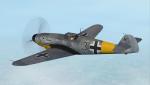
Bf109G-2_2.JG53
(Category: CFS2 > Aircraft)
11.64Mb (8 downloads)
Messerschmitt Bf109G-2
by Design Team Daedalus
Unit: 2./JG53 Stalingrad, Russia, Summer 1942
Pilot: unknown
During the summer of 1941, the Messerschmitt design team was engaged in updating the BF 109F-4 as the dictates of the air war was forcing the need for greater speeds. The result was the Gustav series, of which the first substantial production run was the Bf 109G-2. Adopting the more powerful but heavier Mercedes Benz DB 605 engine required airframe and landing gear strengthening which also added weight. But it was felt the increase in speed made the loss of some maneuverability acceptable. The fuel filler access was moved to the spine behind the cockpit. No change was required for the cowling shape but a deeper oil cooler was needed. The broad blade of the F4/Z was made standard. The lower quarter cockpit window panel was deleted and vent scoops could be added to the new replacement metal panel. The wheel wells reverted to a squared end in anticipation of wheel covers that in the event were not adopted. Generally speaking the appearance of the G-2 was very similar to the F-4 without close examination. Deliveries of the G-2 began in May 1942 with 1,587 produced by February 1943.
However, there is no "standard" Bf 109G-2. Although production only ran 10 months before the G-3 and G-4 were introduced, three separate companies and multiple sub-assembly production facilities were involved which inevitably produced minor variations, such as pilot head armor type, cockpit vents and tail wheel types. So each model we have created has its own unique features to portray the specific aircraft presented as accurately as possible.
This aircraft had a cockpit vent on the starboard side only, an unusual G-1 type pilot head armor, and a retractable tail wheel.
Pstrany developed the models using Paul Rebuffat's Messerschmitt model - with permission - as a starting framework and updated the shape, and added a plethora of details, new parts, and ideas. Pstrany also developed the models for the drop tanks, weapons and racks.
Captain Kurt created paints for each, the 2D instrument panel, the individual .dp files, the air files and the aircraft.cfg files.
Mav SCASM edited each model so that they have animated wing slats, drop tanks, and other features, as well as optimizing models for the best possible framerates. Mav also developed the idea for the 2d panel to be offset for the Revi gunsight to match the CFS2 reticle.
Posted Oct 4, 2025 21:39 by Design Team Daedalus
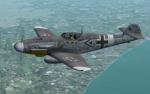
Bf109G-2_Trop_StabJG77
(Category: CFS2 > Aircraft)
13.41Mb (8 downloads)
Messerschmitt Bf109G-2/Trop
by Design Team Daedalus
Unit: Stab/JG77 Comiso, Italy September 1943
Pilot: Maj. Heinz Bar
During the summer of 1941, the Messerschmitt design team was engaged in updating the BF 109F-4 as the dictates of the air war was forcing the need for greater speeds. The result was the Gustav series, of which the first substantial production run was the Bf 109G-2. Adopting the more powerful but heavier Mercedes Benz DB 605 engine required airframe and landing gear strengthening which also added weight. But it was felt the increase in speed made the loss of some maneuverability acceptable. The fuel filler access was moved to the spine behind the cockpit. No change was required for the cowling shape but a deeper oil cooler was needed. The broad blade of the F4/Z was made standard. The lower quarter cockpit window panel was deleted and vent scoops could be added to the new replacement metal panel. The wheel wells reverted to a squared end in anticipation of wheel covers that in the event were not adopted. Generally speaking the appearance of the G-2 was very similar to the F-4 without close examination. Deliveries of the G-2 began in May 1942 with 1,587 produced by February 1943.
The Tropical version had a sand filter for the supercharger, umbrella attachment points under the canopy on the port side, sand proofing rubber seals around hydraulic cylinders (not visible) and survival gear and a Kar98 rifle stowed in the aft fuselage (also not visible).
However, there is no "standard" Bf 109G-2. Although production only ran 10 months before the G-3 and G-4 were introduced, three separate companies and multiple sub-assembly production facilities were involved which inevitably produced minor variations, such as pilot head armor type, cockpit vents and tail wheel types. So each model we have created has its own unique features to portray the specific aircraft presented as accurately as possible.
Besides the sand filter, this aircraft had a 2 piece curved top pilot head armor, cockpit vents on both sides, the port side umbrella attachment fixtures, and a retractable tail wheel.
Pstrany developed the models using Paul Rebuffat's Messerschmitt model - with permission - as a starting framework and updated the shape, and added a plethora of details, new parts, and ideas. Pstrany also developed the models for the drop tanks, weapons and racks.
Captain Kurt created paints for each, the 2D instrument panel, the individual .dp files, the air files and the aircraft.cfg files.
Mav SCASM edited each model so that they have animated wing slats, drop tanks, and other features, as well as optimizing models for the best possible framerates. Mav also developed the idea for the 2d panel to be offset for the Revi gunsight to match the CFS2 reticle.
Posted Oct 4, 2025 21:19 by Design Team Daedalus
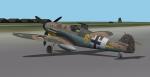
Bf109G-2_Trop_6JG53
(Category: CFS2 > Aircraft)
13.48Mb (8 downloads)
Messerschmitt Bf109G-2/Trop
by Design Team Daedalus
Unit: 6./JG53 El Aouina, Tunisia and Sicily January 1943
Pilot: unknown
During the summer of 1941, the Messerschmitt design team was engaged in updating the BF 109F-4 as the dictates of the air war was forcing the need for greater speeds. The result was the Gustav series, of which the first substantial production run was the Bf 109G-2. Adopting the more powerful but heavier Mercedes Benz DB 605 engine required airframe and landing gear strengthening which also added weight. But it was felt the increase in speed made the loss of some maneuverability acceptable. The fuel filler access was moved to the spine behind the cockpit. No change was required for the cowling shape but a deeper oil cooler was needed. The broad blade of the F4/Z was made standard. The lower quarter cockpit window panel was deleted and vent scoops could be added to the new replacement metal panel. The wheel wells reverted to a squared end in anticipation of wheel covers that in the event were not adopted. Generally speaking the appearance of the G-2 was very similar to the F-4 without close examination. Deliveries of the G-2 began in May 1942 with 1,587 produced by February 1943.
The Tropical version had a sand filter for the supercharger, umbrella attachment points under the canopy on the port side, sand proofing rubber seals around hydraulic cylinders (not visible) and survival gear and a Kar98 rifle stowed in the aft fuselage (also not visible).
However, there is no "standard" Bf 109G-2. Although production only ran 10 months before the G-3 and G-4 were introduced, three separate companies and multiple sub-assembly production facilities were involved which inevitably produced minor variations, such as pilot head armor type, cockpit vents and tail wheel types. So each model we have created has its own unique features to portray the specific aircraft presented as accurately as possible.
Besides the sand filter, this aircraft had the port side umbrella attachment fixtures, a cockpit vent on boyh sides, a flat plate pilot armor and a retractable tail wheel.
Pstrany developed the models using Paul Rebuffat's Messerschmitt model - with permission - as a starting framework and updated the shape, and added a plethora of details, new parts, and ideas. Pstrany also developed the models for the drop tanks, weapons and racks.
Captain Kurt created paints for each, the 2D instrument panel, the individual .dp files, the air files and the aircraft.cfg files.
Mav SCASM edited each model so that they have animated wing slats, drop tanks, and other features, as well as optimizing models for the best possible framerates. Mav also developed the idea for the 2d panel to be offset for the Revi gunsight to match the CFS2 reticle.
Posted Oct 4, 2025 21:15 by Design Team Daedalus
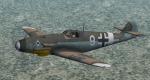
Bf109G-2_Trop_4JG53
(Category: CFS2 > Aircraft)
12.17Mb (8 downloads)
Messerschmitt Bf109G-2/Trop
by Design Team Daedalus
Unit: 4./JG53 Libya 1942
Pilot: unknown
During the summer of 1941, the Messerschmitt design team was engaged in updating the BF 109F-4 as the dictates of the air war was forcing the need for greater speeds. The result was the Gustav series, of which the first substantial production run was the Bf 109G-2. Adopting the more powerful but heavier Mercedes Benz DB 605 engine required airframe and landing gear strengthening which also added weight. But it was felt the increase in speed made the loss of some maneuverability acceptable. The fuel filler access was moved to the spine behind the cockpit. No change was required for the cowling shape but a deeper oil cooler was needed. The broad blade of the F4/Z was made standard. The lower quarter cockpit window panel was deleted and vent scoops could be added to the new replacement metal panel. The wheel wells reverted to a squared end in anticipation of wheel covers that in the event were not adopted. Generally speaking the appearance of the G-2 was very similar to the F-4 without close examination. Deliveries of the G-2 began in May 1942 with 1,587 produced by February 1943.
The Tropical version had a sand filter for the supercharger, umbrella attachment points under the canopy on the port side, sand proofing rubber seals around hydraulic cylinders (not visible) and survival gear and a Kar98 rifle stowed in the aft fuselage (also not visible).
However, there is no "standard" Bf 109G-2. Although production only ran 10 months before the G-3 and G-4 were introduced, three separate companies and multiple sub-assembly production facilities were involved which inevitably produced minor variations, such as pilot head armor type, cockpit vents and tail wheel types. So each model we have created has its own unique features to portray the specific aircraft presented as accurately as possible.
Besides the sand filter, this aircraft had a flat plate pilot head armor, and a retractable tail wheel. The cockpit vent on the starboard side was replaced by a flare tube. It's unknown if it had the port side umbrella attachment fixtures but since it is likely, we provided them.
Pstrany developed the models using Paul Rebuffat's Messerschmitt model - with permission - as a starting framework and updated the shape, and added a plethora of details, new parts, and ideas. Pstrany also developed the models for the drop tanks, weapons and racks.
Captain Kurt created paints for each, the 2D instrument panel, the individual .dp files, the air files and the aircraft.cfg files.
Mav SCASM edited each model so that they have animated wing slats, drop tanks, and other features, as well as optimizing models for the best possible framerates. Mav also developed the idea for the 2d panel to be offset for the Revi gunsight to match the CFS2 reticle.
Posted Oct 4, 2025 21:12 by Design Team Daedalus
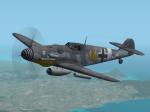
BF109G-6-trop_12.JG3
(Category: CFS2 > Aircraft)
14.03Mb (8 downloads)
Messerschmitt Bf109G-6/R6 trop
by Design Team Daedalus
Unit: 12./JG3 San Severo, Italy August 1943
Pilot: unknown
There is no "standard" Bf 109G-6, as the production run spanned 2 years it underwent many modifications and updates along the way. Tropical versions were delivered throughout the entire production runs as the G-6 trop but had fewer variations. For example I have not seen any G-6 trop aircraft fitted with an Erla Haube canopy while many G-6 versions were so fitted. The most obvious feature of the G-6 trop was the sand filter fitted to the front of the supercharger air intake. All G-6 trop aircraft had two small teardrop shaped clips on the port side below the canopy sill, which were mounts for a sun umbrella. The umbrella was intended to provide shade for the cockpit while the aircraft was at readiness. Different weapons packages could be seen such as the 20mm under wing gondolas and more rarely, the WGr21 under wing rocket tubes such as equipped this aircraft. Most G-6 trops were sent to the Mediterranean operations areas and some to the southern Russian/Balkans front area.
Pstrany developed the models using Paul Rebuffat's Messerschmitt model - with permission - as a starting framework and updated the shape, and added a plethora of details, new parts, and ideas. Pstrany also developed the models for the drop tanks, weapons and racks.
Captain Kurt created paints for each, the 2D instrument panel, the individual .dp files, the air files and the aircraft.cfg files.
Mav SCASM edited each model so that they have animated wing slats, drop tanks, and other features, as well as optimizing models for the best possible framerates. Mav also developed the idea for the 2d panel to be offset for the Revi gunsight to match the CFS2 reticle.
We have all benefited from the assistance and guidance of others in the community, Special thanks to Wolfi and Huub Vink for their kind assistance and to all who have contributed their knowledge directly and indirectly.
Posted Oct 4, 2025 20:49 by Design Team Daedalus
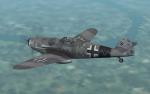
Bf109G-14_16.JG53
(Category: CFS2 > Aircraft)
13.18Mb (8 downloads)
Messerschmitt Bf109G-14
by Design Team Daedalus
Unit: 16./JG53 W.Nr. 462892
Pilot: Gefr.Alfred Michel (POW). Shot down near Waldweistroff by US Army anti-aircraft fire during Operation Bodenpaltte January 1, 1945.
The first Bf109G-14 fighters reached front line units in the summer of 1944. It was flown by virtually all of the Bf109 equipped units.
The G-14 version was an attempt to standardize a new type that would incorporate all of the plethora of changes introduced during the production of the G-6. The many changes and the ensuing problems associated with decentralized mass production had led to a great number of G-6 variations.
The effort was a complete failure because the G-14 wound up with as many variations as the G-6. Some had the small tail of the earlier G-6 while some had a tall rudder which came in several different versions. Some were wood, some were fabric covered, some had a rounded lower rear edge, some had a sharp angled rear edge and there were several variations of trim tabs. There were different antenna types and some had no antenna at all.
However there were some standards. It was powered by the DB605 AM engine with MW-50 injection and had the Erla Haube canopy. Most all had the FuG 16ZY radio with the antenna mast installed under the port wing outboard of the wheel well.
Pstrany developed the models using Paul Rebuffat's Messerschmitt model - with permission - as a starting framework and updated the shape, and added a plethora of details, new parts, and ideas. Pstrany also developed the models for the drop tanks, weapons and racks.
Captain Kurt created paints for each, the 2D instrument panel, the individual .dp files, the air files and the aircraft.cfg files.
Mav SCASM edited each model so that they have animated wing slats, drop tanks, and other features, as well as optimizing models for the best possible framerates. Mav also developed the idea for the 2d panel to be offset for the Revi gunsight to match the CFS2 reticle.
Posted Oct 4, 2025 18:16 by Design Team Daedalus