



All Time Popular > Page 5495
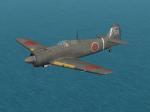
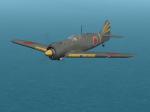
AW Ki-100 TEXTURE SET 1
(Category: CFS2 > Misc)
11.16Mb (21 downloads)
Texture file: painted by UncleTgt
This is a copyrighted freeware program.Use this program at you own risks, the
author is not responsible for any damages done to your computer.
Thanks for downloading this aircraft, have fun!
Andrew Wai
Required files:
required file
Posted Aug 19, 2024 04:46 by Andrew
TruNorthSim Feelthere EJets Lighting Mod
(Category: Prepar3d > Payware)
13.25Mb (21 downloads)
The purpose of this addon is to fix several issues with the Feelthere EJets aircraft
night lighting. This mod was created using the original EJets, not V3. 1. Adjusted the landing lights on the aircraft's wings, so that they no longer shine into the cockpit at night 2. Included a new beacon light effect that doesn't blink into the cockpit 3. Changed the line in each of the aircraft's configs that specifies which beacon light effect to use from fx_beaconb and fx_beaconh to fx_usethisbeacon. Don't forget to visit my Facebook @TruNorthSim to leave a comment or request support!
Posted Oct 16, 2021 02:14 by TruNorthSim
CFS
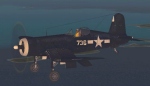
Corsair Repaint: Maj JACK E CONGER "Smiling Jack"
(Category: CFS2 > Aircraft)
(21 downloads)
CFS
Corsair Repaint: Maj JACK E CONGER "Smiling Jack"
of VMF-114 while on Peleliu in this corsair Jack deep sixed a Jap
destroyer with Cowboy flying his wing. Maj Conger first saw combat
with VMF-212 on Guadalcanal during Oct an Nov of 1942 as part of the
Catus Airforce before being assigned to VMF-114 an finished the war
with a record of 10.5 victories an one Destroyer repaint by Straw_VMF114.
2.5MB
Posted Jun 10, 2008 11:32 by archive
Bf109E-1_6.JG52
(Category: CFS2 > Aircraft)
7.79Mb (20 downloads)
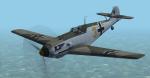
Messerschmitt Bf 109E-1
by Design Team Daedalus
Unit: 6./JG52 March 1940 Speyer Germany
Pilot: unknown
To improve on the performance afforded by the 690 hp Jumo 210 of the earlier Bf 109 versions, the larger, longer 1080 hp Daimler-Benz DB 601A engine was used. As a consequence, the nose, cooling system, and wings had to be redesigned resulting in the classic Bf 109 series. In late 1938, the Bf 109E entered production. It entered general service with the Luftwaffe in the spring of 1939. A total of 1,183 E-1 were built, 110 of them were E-1/B fighter bomber versions.
There were many small differences between individual E-1s because the E-1 was often modified in the field by groundcrew and rear area repair depots. The production standard was lightly armed with two 7.92mm MG17s above the engine and two in the wings and had no pilot armor. Mods included types of pilot head armor,E-4 type squared canopies, E-7 type pointed spinners, etc., but changing the wing MG17 armament required new different wings.
So each model we have created has its own unique features. This model is the basic factory production standard.
By the time the later Bf 109E-4 and Bf 109E-7 marks were equipping the Jagdgeschwaders a program was initiated to withdraw and remanufacture the surviving E-1s to either full E-4 or E-7 standard.
Pstrany is the primary model author with some small model refinement and additions by Captain Kurt as the model was collaborated on during development. Captain Kurt created the textures for each, the 2D instrument panel, the individual .dp files, air files and aircraft.cfg files.
Posted Oct 12, 2025 16:12 by Design Team Daedalus
Bf109E4BTrop_2.LG2
(Category: CFS2 > Aircraft)
10.58Mb (20 downloads)
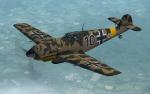
Messerschmitt Bf 109E-4/B trop
by Design Team Daedalus
Unit: 2.(J)/LG2 Tudora-Botosani, Romania June 1941
Pilot: Ltn. Hans Guse KIA
The E-3 was replaced by the E-4 (with many airframes being upgraded to E-4 standards starting at the beginning of the Battle of Britain), which was different in some small details, most notably by using the modified 20 mm MG-FF/M wing cannon and having improved head armor for the pilot. With the MG FF/M, it was possible to fire a new and improved type of explosive shell, called Minengeschoß (or 'mine-shell'), which was made using drawn steel (the same way brass cartridges are made) instead of being cast as was the usual practice. This resulted in a shell with a thin but strong wall, which had a larger cavity in which to pack a much larger explosive charge than was otherwise possible. The new shell required modifications to the MG FF's mechanism due to the different recoil characteristics, hence the MG FF/M designation.
The cockpit canopy was also revised to an easier-to-produce, "squared-off" design, which also helped improve the pilot's field of view. This canopy, which was also retrofitted to many E-1s and E-3s, was largely unchanged until the introduction of a welded, heavy-framed canopy on the G series in the autumn of 1942. The E-4 would be the basis for all further Bf 109E developments. Some E-4 and later models received a further improved 1,175 PS (1,159 hp, 864 kW) DB601N high-altitude engine; known as the E-4/N; owing to priority being given to equipping Bf 110s with this engine, one fighter gruppe was converted to this version, starting in July 1940.[21] The E-4 was also available as a fighter-bomber with equipment very similar to the previous E-1/B. It was known as E-4/B (DB 601Aa engine) and E-4/BN (DB 601N engine). A total of 561 of all E-4 versions were built,[13] including 496 E-4s built as such: 250 E-4, 211 E-4/B, 15 E-4/N and 20 E-4/BN.
There were many small differences between individual E-4s because the E-4 was often modified in the field by groundcrew and rear area repair depots. The production standard had no pilot armor. Mods included types of pilot head armor, armored windscreen, tropical sand filters, E-7 type pointed spinners, etc.
So each model we have created has its own unique features. This aircraft was an E-4/B modified with a tropical sand filter, and a flat plate pilot head armor. Still carrying a sand and mottle camouflage from the Greek campaign, it took part in the opening stage of Operation Barbarossa until it was shot down by a Soviet Polikarpov I-16 on July 10, 1941
Pstrany is the primary model author with some small model refinement and additions by Captain Kurt as the model was collaborated on during development. Captain Kurt created the textures for each, the 2D instrument panel, the individual .dp files, air files and aircraft.cfg files.
Posted Oct 12, 2025 16:06 by Design Team Daedalus
Bf109K-4_12.JG27
(Category: CFS2 > Aircraft)
12.86Mb (20 downloads)
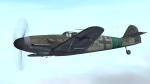
Messerschmitt Bf 190K-4
unit: 12./JG27
pilot: unknown
The Bf 109 Kurfürst was evolved from the Bf 109G-10. The K series was a response to the fact that the bewildering array of series, models, modification kits and factory conversions for the various Bf 109G versions led to logistic problems, making production and maintenance complicated and costly - something Germany could ill-afford late in the war. As such, the RLM (German Aviation Ministry) ordered Messerschmitt to rationalize production of the Bf 109, consolidating parts, types etc to produce a uniform, standard model with better interchangeability of parts and equipment.The "Kurfürst" version was the last and most powerful series of the Bf 109, with only the Bf 109 K-4 being built in large large numbers.
Important features of the "Kurfürst" were the DB 605 DM engine, which was powered by the DB 603's large supercharger. The armament was the MK 108 cannon firing through the propeller hub and a pair of MG 131 machine guns in the upper cowling. The main landing gear had small gear doors covering the retracted wheels fitted in addition to main gear doors, and the tail wheel was also fully retractable with covering doors. Larger wheels measuring 660x190 on 13" rims were used so that the machine could carry the higher flying weight. The retracted larger wheels required rectangular bulges on the wing tops to clear the wheels.
The antenna mast was mostly no longer used at the factory to reduce air resistance and make parachuting safer for the pilot. The DF antenna of the FuG 16 ZY on the back of the fuselage was moved further back to fuselage part 3. The radio access cover, which was previously always in fuselage part 5, was moved forward to fuselage part 4 because of modified installations.
As with other BF 109 versions, there were were variations between individual planes due to dispersed manufacturing and parts shortages forced by Allied bombing.
This aircraft had the small main gear doors removed, a fuselage mounted antenna wire, and a fixed tail wheel gear.
-------------------------------------------------------------------------------------------------------------------------------
Pstrany and Captain Kurt developed the models using Paul Rebuffat's Messerschmitt model - with permission - as a starting framework and updated the shape, and added a plethora of details, new parts, and ideas. Pstrany also developed the models for the drop tanks, weapons and racks.
Captain Kurt created paints for each, the 2D instrument panel, the individual .dp files, the air files and the aircraft.cfg files.
Mav developed the idea for the 2d panel to be offset for the Revi gunsight to match the CFS2 reticle.
Posted Oct 9, 2025 01:54 by Design Team Daedalus
TruNorthSim Spartan Executive No Clear Prop Sound Mod
(Category: MSFS 2020 > Payware)
0.01Mb (20 downloads)
The purpose of this mod is to remove the "Clear prop" callout made when you open the start button cover. This mod requires the payware version of the Spartan Executive by HCG Digital Arts LTD.
Posted May 30, 2023 08:04 by TruNorthSim
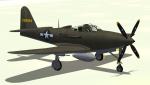
P-63A Kingcobra
(Category: CFS2 > Aircraft)
4.87Mb (19 downloads)
Bell P-63A Kingcobra
Bell designed the P-63 with the intention of improving the high altitude performance failure of the P-39 Airacobra. Although similar looking, the P-63 was a totally new aircraft; being larger with a laminer flow wing, supercharging, etc. Despite its improvements, the P-63 never lived up to the level of the P-51, Corsair, or other late-war front line fighters. The P-63 never saw combat in USAAF squadrons. Some 76% of the 3300 planes went to the Soviet Union, where their service record is largely unknown. Another 300 planes went to the Free French squadrons, seeing Viet Nam action.
The US Army Air Force (USAAF) order for two prototypes in June 1941 launched the P-63 Kingcobra. Further prototypes followed before deliveries of the first production version began in October 1943.
Production deliveries of the P-63A began in October of 1943, and by December of 1944 1725 P-63As had been produced. The USAAF never saw fit to use the Kingcobra for operational combat missions, since by that time in the war the need for a high altitude fighter was met by the P-38 and P-51, and low-altitude close-support fighter aircraft was more than adequately filled by such aircraft as the P-47 Thunderbolt. Regardless, P-63As did serve for a few months with the 31st, 444th, and 445th Squadrons while they were based Stateside.
Credits
Captain Kurt: Aircraft model, drop tank, VC, paint textures, 2D panel.
ACWai contributed the landing gear designs.
Shessi: Pilot figure
Kelticheart: Prop blurred texture
Gauges: AliCat, ACWai, Microsoft, and others unknown
714/257th 1% Aircraft: aircraft.cfg, air file, and .dp
Posted Mar 31, 2026 15:54 by Captain Kurt
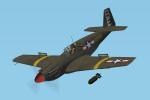
North American A-36A Invader
(Category: CFS2 > Aircraft)
10.84Mb (19 downloads)
North American A-36A Invader
Unit: 533Rd FBS, 27th FBG at Sicily 1943
April 1942 marked the first order of any P-51 variant by the US Army. 500 NA-97s were ordered. The U.S. serials were 42-83663 to 42-84162. The P-51 was never intended to be a dive bomber. Budgets for pursuit fighters were limited at that time, but there were funds available for dive bombers. NAA's President, Dutch Kindelberger, made proposals for a quick design modification to the P-51 and landed a contract for 500 A-36A's.
Although "Apache" was the A-36A's official name, it was rarely used.Units in Africa and Italy called it the "Invader" and the name eventually found its way into offical USAAF use.
The design was very similar to the Mustang I and P-51A. The powerplant was the Allison V-1710-87. The A-36 was a dive-bomber so the addition of hard points for two 500 lb bombs and dive brakes to slow the fast acceleration of the P-51 in a dive were added. The belly scoop was now fixed at the front. Armament was 2 guns in the nose and 4 in the wings, all .50 caliber.
The dive brakes were operated hydraulically and located on the top and bottom of each wing outboard of the guns. Plan was that they limit the dive speed to 250 mph but in practice the speeds were closer to 350 mph and higher. The angle of dive was reduced to 70 degrees because of high stress during pull-out.
The hard points for the bombs were also capable of holding 75 gallon drop tanks for extended range. The top speed of the A-36 was down from added weight to about 358 mph at 5,000 feet (without external stores).
The US used the A-36 in the Mediterranean theatre with first deliveries beginning in early 1943. When not in the ground attack role, the A-36 was essentially a low-altitude P-51A and was used as a fighter. The A-36 scored 101 air-air victories during WWII.
The A-36 proved to be a very stable platform for accurate weapons delivery. 177 were lost in action mostly due to the dangerous mission of low-level operations.
Credits
Captain Kurt: Aircraft model, drop tank, VC, paint textures, 2D panel, aircraft.cfg, air file, and .dp
Shessi: Pilot figure
Kelticheart: Prop blurred texture
Other ordinance: FDG Team
Gauges: AliCat, ACWai, Microsoft, and others unknown
Sound: razcal -- The Allison V-1710-81 for the P-40 but same engine in the P-51A
Posted Mar 18, 2026 15:18 by Captain Kurt
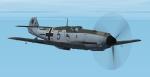
Bf109E-1_5.JG26
(Category: CFS2 > Aircraft)
8.39Mb (19 downloads)
Messerschmitt Bf 109E-1
by Design Team Daedalus
Unit: 5./JG 26 July, 1940 Marquise, France
Pilot: Lt. Hans Krug
To improve on the performance afforded by the 690 hp Jumo 210 of the earlier Bf 109 versions, the larger, longer 1080 hp Daimler-Benz DB 601A engine was used. As a consequence, the nose, cooling system, and wings had to be redesigned resulting in the classic Bf 109 series. In late 1938, the Bf 109E entered production. It entered general service with the Luftwaffe in the spring of 1939. A total of 1,183 E-1 were built, 110 of them were E-1/B fighter bomber versions.
There were many small differences between individual E-1s because the E-1 was often modified in the field by groundcrew and rear area repair depots. The production standard was lightly armed with two 7.92mm MG17s above the engine and two in the wings and had no pilot armor. Mods included types of pilot head armor,E-4 type squared canopies, E-7 type pointed spinners, etc., but changing the wing MG17 armament required new different wings.
So each model we have created has its own unique features. This model is the basic factory production standard, but we have chosen to include it because of the unique history of its pilot Ltn. Hans Krug.
He was born in 1899 and served in various Royal Bavarian aviation units during the Great War. He was flying combat missions from March till May 1918. Considered too old for fighter pilot in Germany during the mid-1930s, he then joined the Spanish Nationalist air force instead of Legion Condor like other German volunteers . Krug often flew alongside Spanish ace Joaquin Garcia Morato, whose Fiat CR.32 carried bullfighting motto VISTA SUERTE Y AL TORO (The look, good fortune and go for the bull!). Krug adopted this inscription on his Emil when he was finally accepted into Luftwaffe with rank of Leutnant, and entered successful service with II./JG 26 Schlageter . With 5./JG 26 he scored five victories during French campaign including one unconfirmed. Krug scored additional five victories during Battle of Britain and took over leadership of 4./JG 26. At the time he was 41 years old and the only World War One pilot who became a World War Two ace! He was shot down by RAF fighters over England, belly landing near Pluckley on September 7, 1940 to become a POW.
Pstrany is the primary model author with some small model refinement and additions by Captain Kurt as the model was collaborated on during development. Captain Kurt created the textures for each, the 2D instrument panel, the individual .dp files, air files and aircraft.cfg files.
Posted Oct 12, 2025 16:11 by Design Team Daedalus