



All Time Popular > Page 5499
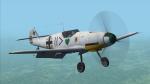
Bf109F-2_JG54
(Category: CFS2 > Aircraft)
18.52Mb (14 downloads)
Messerschmitt Bf109F-2
by Design Team Daedalus
Unit: I./JG54 Krasnogvardeisk, USSR March, 1942
Pilot: Maj Hans Phillip
There is no "standard" Bf 109F-2, as the production run underwent many small modifications and there were field implemented updates along the way. So each model we have created has it's own unique features.
Pstrany developed the models using Paul Rebuffat's Messerschmitt model - with permission - as a starting framework and updated the shape, and added a plethora of details, new parts, and ideas. Pstrany also developed the models for the drop tanks, weapons and racks.
Captain Kurt created paints for each, the 2D instrument panel, the individual .dp files, the air files and the aircraft.cfg files.
Mav SCASM edited each model so that they have animated wing slats, drop tanks, and other features, as well as optimizing models for the best possible framerates. Mav also developed the idea for the 2d panel to be offset for the Revi gunsight to match the CFS2 reticle.
The engine sound package is by Lawdog2360
Posted Oct 8, 2025 23:00 by Design Team Daedalus
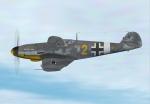
Bf109F-4Z_3.JG77
(Category: CFS2 > Aircraft)
16.52Mb (14 downloads)
Messerschmitt Bf109F-4/Z
by Design Team Daedalus
Unit: 3./JG77 Comiso, Italy July, 1942
Pilot: Uffz Karl-Heinz Witschke
There is no "standard" Bf 109F-4, as the production run underwent many small modifications and there were field implemented updates along the way. So each model we have created has it's own unique features.
Pstrany developed the models using Paul Rebuffat's Messerschmitt model - with permission - as a starting framework and updated the shape, and added a plethora of details, new parts, and ideas. Pstrany also developed the models for the drop tanks, weapons and racks.
Captain Kurt created paints for each, the 2D instrument panel, the individual .dp files, the air files and the aircraft.cfg files.
Mav SCASM edited each model so that they have animated wing slats, drop tanks, and other features, as well as optimizing models for the best possible framerates. Mav also developed the idea for the 2d panel to be offset for the Revi gunsight to match the CFS2 reticle.
Posted Oct 8, 2025 22:52 by Design Team Daedalus
CFS2
Hiryu B5N2 KATE Textures only
(Category: CFS2 > Aircraft)
(14 downloads)
CFS2
Hiryu B5N2 KATE Textures only for The B24 Guy's Overhaul B5N2
Model."B5N2" Texture and Damage Files Only.Author: Evan
G. Butterbrodt. 1.9MB
Posted Jun 10, 2008 11:31 by archive
FS98 Scenery: Lands End Gliderport
(Category: FS98 > Gliders and Ultralites)
0.01Mb (14 downloads)
FS98
Scenery: Lands End Gliderport / Oklahoma. File size 5664.
Colin Graham
Posted Jun 23, 2008 14:18 by archive
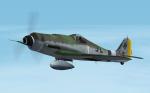
Focke Wulf Fw 190D-9 R4m rockets
(Category: CFS2 > Aircraft)
9.48Mb (13 downloads)
Focke Wulf Fw 190D-9 R4m rockets
by Design Team Daedalus
Unit: 5./JG26
Pilot: unknown
The Fw 190D-9 combined the Fw 190A-8 fuselage and wings with the Jumo 213A-1 engine to create a higher altitude capable fighter than the A-8. The first production aircraft were completed at Focke-Wulf’s factory at Sorau in Silesia in late August 1944. Problems with engine meant that the second aircraft wasn’t completed until mid-September, but construction soon sped up. By the end of September production was underway at Focke-Wulf’s factory at Cottbus, and in October work began at Roland (WFG) at Nordenahm and Fieseler at Kassel. Junkers and Siebel produced parts, and Arado was also involved in the program. The total number produced is unclear, with at least 670 known and no records for December 1944 or February 1945 to the end of the war. 1,500 serial numbers are known to have been allocated to the D-9, but that doesn’t mean that all of these aircraft were completed.
The standard D-9 was armed with two 13mm MG 131 machine guns above the engine and two 20mm MG 151 cannon in the wing roots. It could carry an ETC 501 or ETC 504 stores carriers below the fuselage. This aircraft also was equipped with underwing R4m rocket racks.
The first D-9 unit, III./JG 54, began to convert to the type in September 1944, and by the end of October had 68 aircraft, of which only one had the MW 50 installed. However 53 had been given a new Junkers kit that increased the manifold pressure in the engine and boosted power from 1,750hp to around 1,870hp.
By the end of December 1944 there were 183 D-9s in service with three units (III./JG 54, II./JG 26 and III./JG 26), with some equipped with both the MW 50 and Junkers kits, some with one or the other and some without either. However new aircraft coming off the production line mainly had both.
Early in 1945 the D-9 was issued to JG 2, JG 3, JG 6, JG 51 and JG 301, although these units normally operated a mix of types. In service the D-9 was considered to be as good as its main opponents, in particular the Merlin powered P-51 Mustangs and the Griffon powered Spitfire Mk.XIV. It handled better than the Fw 190A, was faster and climbed quicker. It could out-turn most Soviet fighters at the normal combat levels, and was quicker in the dive than the Yak-3 or Yak-9.
It was a very good fighter for that time but was too little too late to have any effect on the course of the war.
--------------------------------------------------------------------------------------------------------------------------------------------------------------------
Captain Kurt developed the model from the old Pstrany Dora model - with permission - as a starting framework and updated the shape, and added multiple details, new parts, new VC, and animations. The original Pstrany airfiles, and Dora weapons models for the drop tanks, weapons, and racks are still used as is the Jumo sound package (included)
Captain Kurt also created the camouflage paint, and the 2D instrument panel.
Posted Feb 7, 2026 22:44 by Design Team Daedalus
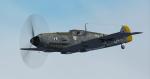
Bf109E4_7.JG2
(Category: CFS2 > Aircraft)
9.41Mb (13 downloads)
Messerschmitt Bf 109E-4
by Design Team Daedalus
Unit: 7./JG2 Beamont-le-Roger August 1940
Pilot: Fw. Ludwig Bielmeier
The E-3 was replaced by the E-4 (with many airframes being upgraded to E-4 standards starting at the beginning of the Battle of Britain), which was different in some small details, most notably by using the modified 20 mm MG-FF/M wing cannon and having improved head armor for the pilot. With the MG FF/M, it was possible to fire a new and improved type of explosive shell, called Minengeschoß (or 'mine-shell'), which was made using drawn steel (the same way brass cartridges are made) instead of being cast as was the usual practice. This resulted in a shell with a thin but strong wall, which had a larger cavity in which to pack a much larger explosive charge than was otherwise possible. The new shell required modifications to the MG FF's mechanism due to the different recoil characteristics, hence the MG FF/M designation.
The cockpit canopy was also revised to an easier-to-produce, "squared-off" design, which also helped improve the pilot's field of view. This canopy, which was also retrofitted to many E-1s and E-3s, was largely unchanged until the introduction of a welded, heavy-framed canopy on the G series in the autumn of 1942. The E-4 would be the basis for all further Bf 109E developments. Some E-4 and later models received a further improved 1,175 PS (1,159 hp, 864 kW) DB601N high-altitude engine; known as the E-4/N; owing to priority being given to equipping Bf 110s with this engine, one fighter gruppe was converted to this version, starting in July 1940.[21] The E-4 was also available as a fighter-bomber with equipment very similar to the previous E-1/B. It was known as E-4/B (DB 601Aa engine) and E-4/BN (DB 601N engine). A total of 561 of all E-4 versions were built,[13] including 496 E-4s built as such: 250 E-4, 211 E-4/B, 15 E-4/N and 20 E-4/BN.
There were many small differences between individual E-4s because the E-4 was often modified in the field by groundcrew and rear area repair depots. The production standard had no pilot armor. Mods included types of pilot head armor, armored windscreen, tropical sand filters, E-7 type pointed spinners, etc.
So each model we have created has its own unique features. This aircraft was not equipped with any pilot head armor.
Pstrany is the primary model author with some small model refinement and additions by Captain Kurt as the model was collaborated on during development. Captain Kurt created the textures for each, the 2D instrument panel, the individual .dp files, air files and aircraft.cfg files.
Posted Oct 12, 2025 16:00 by Design Team Daedalus
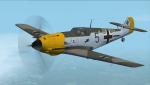
Bf109E4_5.JG26
(Category: CFS2 > Aircraft)
9.24Mb (13 downloads)
Messerschmitt Bf 109E-4
by Design Team Daedalus
Unit: 5./JG26 Abbeville France 1940
Pilot: unknown
The E-3 was replaced by the E-4 (with many airframes being upgraded to E-4 standards starting at the beginning of the Battle of Britain), which was different in some small details, most notably by using the modified 20 mm MG-FF/M wing cannon and having improved head armor for the pilot. With the MG FF/M, it was possible to fire a new and improved type of explosive shell, called Minengeschoß (or 'mine-shell'), which was made using drawn steel (the same way brass cartridges are made) instead of being cast as was the usual practice. This resulted in a shell with a thin but strong wall, which had a larger cavity in which to pack a much larger explosive charge than was otherwise possible. The new shell required modifications to the MG FF's mechanism due to the different recoil characteristics, hence the MG FF/M designation.
The cockpit canopy was also revised to an easier-to-produce, "squared-off" design, which also helped improve the pilot's field of view. This canopy, which was also retrofitted to many E-1s and E-3s, was largely unchanged until the introduction of a welded, heavy-framed canopy on the G series in the autumn of 1942. The E-4 would be the basis for all further Bf 109E developments. Some E-4 and later models received a further improved 1,175 PS (1,159 hp, 864 kW) DB601N high-altitude engine; known as the E-4/N; owing to priority being given to equipping Bf 110s with this engine, one fighter gruppe was converted to this version, starting in July 1940.[21] The E-4 was also available as a fighter-bomber with equipment very similar to the previous E-1/B. It was known as E-4/B (DB 601Aa engine) and E-4/BN (DB 601N engine). A total of 561 of all E-4 versions were built,[13] including 496 E-4s built as such: 250 E-4, 211 E-4/B, 15 E-4/N and 20 E-4/BN.
There were many small differences between individual E-4s because the E-4 was often modified in the field by groundcrew and rear area repair depots. The production standard had no pilot armor. Mods included types of pilot head armor, armored windscreen, tropical sand filters, E-7 type pointed spinners, etc.
So each model we have created has its own unique features. This aircraft was modified with a flat plate plus curved top pilot head armor and an armored glass windscreen.
Pstrany is the primary model author with some small model refinement and additions by Captain Kurt as the model was collaborated on during development. Captain Kurt created the textures for each, the 2D instrument panel, the individual .dp files, air files and aircraft.cfg files.
Posted Oct 12, 2025 15:57 by Design Team Daedalus

Bf109E3_6.JG53
(Category: CFS2 > Aircraft)
8.27Mb (13 downloads)
Messerschmitt Bf 109E-3
by Design Team Daedalus
Unit: 6./JG 53 1940, France
Pilot: Oblt Heinz Bretnutz
To improve the performance of the Bf 109E, the last two real prototypes (V16 and V17) were constructed. These received some structural improvements and more powerful armament. Both were the basis of the Bf 109 E-3 version. The E-3 was armed with the two MG 17s above the engine and one MG FF cannon in each wing. Some units began recieving the E-3 by September 1939. A total of 1,276 E-3 were built, including 83 E-3a export versions.
There were many small differences between indivual E-3s because the E-3 was often modified in the field by groundcrew and rear area repair depots. The production standard had no pilot armor. Mods included types of pilot head armor,E-4 type squared canopies, E-7 type pointed spinners, etc.
So each model we have created has its own unique features. This aircraft had no pilot head armor but was fitted with a rear view mirror on top of the windscreen frame.
Pstrany is the primary model author with some small model refinement and additions by Captain Kurt as the model was collaborated on during development. Captain Kurt created the textures for each, the 2D instrument panel, the individual .dp files, air files and aircraft.cfg files.
Posted Oct 12, 2025 15:49 by Design Team Daedalus
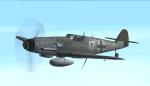
Bf109K-4_9.JG77
(Category: CFS2 > Aircraft)
12.41Mb (13 downloads)
Messerschmitt Bf 190K-4
unit: 9./JG77
pilot: Uffz. Heinrich Munniger
The Bf 109 Kurfürst was evolved from the Bf 109G-10. The K series was a response to the fact that the bewildering array of series, models, modification kits and factory conversions for the various Bf 109G versions led to logistic problems, making production and maintenance complicated and costly - something Germany could ill-afford late in the war. As such, the RLM (German Aviation Ministry) ordered Messerschmitt to rationalize production of the Bf 109, consolidating parts, types etc to produce a uniform, standard model with better interchangeability of parts and equipment.The "Kurfürst" version was the last and most powerful series of the Bf 109, with only the Bf 109 K-4 being built in large large numbers.
Important features of the "Kurfürst" were the DB 605 DM engine, which was powered by the DB 603's large supercharger. The armament was the MK 108 cannon firing through the propeller hub and a pair of MG 131 machine guns in the upper cowling. The main landing gear had small gear doors covering the retracted wheels fitted in addition to main gear doors, and the tail wheel was also fully retractable with covering doors. Larger wheels measuring 660x190 on 13" rims were used so that the machine could carry the higher flying weight. The retracted larger wheels required rectangular bulges on the wing tops to clear the wheels.
The antenna mast was mostly no longer used at the factory to reduce air resistance and make parachuting safer for the pilot. The DF antenna of the FuG 16 ZY on the back of the fuselage was moved further back to fuselage part 3. The radio access cover, which was previously always in fuselage part 5, was moved forward to fuselage part 4 because of modified installations.
As with other BF 109 versions, there were were variations between individual planes due to dispersed manufacturing and parts shortages forced by Allied bombing.
This aircraft had the small main gear doors removed, a fuselage mounted antenna mast, and a fixed tail wheel gear.
-------------------------------------------------------------------------------------------------------------------------------
Pstrany and Captain Kurt developed the models using Paul Rebuffat's Messerschmitt model - with permission - as a starting framework and updated the shape, and added a plethora of details, new parts, and ideas. Pstrany also developed the models for the drop tanks, weapons and racks.
Captain Kurt created paints for each, the 2D instrument panel, the individual .dp files, the air files and the aircraft.cfg files.
Mav developed the idea for the 2d panel to be offset for the Revi gunsight to match the CFS2 reticle.
Posted Oct 9, 2025 01:51 by Design Team Daedalus
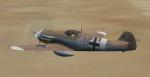
Bf109G-2_Trop_StabJG27
(Category: CFS2 > Aircraft)
12.28Mb (13 downloads)
Messerschmitt Bf109G-2/Trop
by Design Team Daedalus
Unit: Stab/JG27 Bir-el-Abd, Tunesia November 1942
Pilot: Hptm. Gustav Rodel ?
During the summer of 1941, the Messerschmitt design team was engaged in updating the BF 109F-4 as the dictates of the air war was forcing the need for greater speeds. The result was the Gustav series, of which the first substantial production run was the Bf 109G-2. Adopting the more powerful but heavier Mercedes Benz DB 605 engine required airframe and landing gear strengthening which also added weight. But it was felt the increase in speed made the loss of some maneuverability acceptable. The fuel filler access was moved to the spine behind the cockpit. No change was required for the cowling shape but a deeper oil cooler was needed. The broad blade of the F4/Z was made standard. The lower quarter cockpit window panel was deleted and vent scoops could be added to the new replacement metal panel. The wheel wells reverted to a squared end in anticipation of wheel covers that in the event were not adopted. Generally speaking the appearance of the G-2 was very similar to the F-4 without close examination. Deliveries of the G-2 began in May 1942 with 1,587 produced by February 1943.
The Tropical version had a sand filter for the supercharger, umbrella attachment points under the canopy on the port side, sand proofing rubber seals around hydraulic cylinders (not visible) and survival gear and a Kar98 rifle stowed in the aft fuselage (also not visible).
However, there is no "standard" Bf 109G-2. Although production only ran 10 months before the G-3 and G-4 were introduced, three separate companies and multiple sub-assembly production facilities were involved which inevitably produced minor variations, such as pilot head armor type, cockpit vents and tail wheel types. So each model we have created has its own unique features to portray the specific aircraft presented as accurately as possible.
Besides the sand filter, this aircraft had the port side umbrella attachment fixtures, a 2 piece curved top pilot head armor, no cockpit vent on the starboard side, and retractable tail wheel.
Pstrany developed the models using Paul Rebuffat's Messerschmitt model - with permission - as a starting framework and updated the shape, and added a plethora of details, new parts, and ideas. Pstrany also developed the models for the drop tanks, weapons and racks.
Captain Kurt created paints for each, the 2D instrument panel, the individual .dp files, the air files and the aircraft.cfg files.
Mav SCASM edited each model so that they have animated wing slats, drop tanks, and other features, as well as optimizing models for the best possible framerates. Mav also developed the idea for the 2d panel to be offset for the Revi gunsight to match the CFS2 reticle.
Posted Oct 4, 2025 21:17 by Design Team Daedalus