



All Time Popular > Page 5500
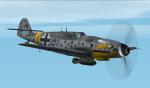
Bf109G-14_III.JG76
(Category: CFS2 > Aircraft)
12.76Mb (13 downloads)
Messerschmitt Bf109G-14
by Design Team Daedalus
Unit: III./JG76 W.Nr. 560593. Athis, France August, 1944.
Pilot: Hptm. Egon Albrecht-Lemke (He was a Brazilian of German ancestry who returned to Germany and joined the Luftwaffe scoring 25 aerial victories). He had a II./ZG1 wasp nose emblem as his unit was originally a Bf110 ground attack Gruppe on the East Front. II./ZG1 was then transferred to Defense of the Reich duties in early 1944. After heavy losses in July 1944, II./ZG1 converted to the Bf109G-14 and was redesignated III./JG76. Gruppenkommandeur Albrecht-Lemke then led the unit in missions over the Normandy invasion front. He was shot down by P-51s and KIA over Creil August 25, 1944.
The first Bf109G-14 fighters reached front line units in the summer of 1944. It was flown by virtually all of the Bf109 equipped units.
The G-14 version was an attempt to standardize a new type that would incorporate all of the plethora of changes introduced during the production of the G-6. The many changes and the ensuing problems associated with decentralized mass production had led to a great number of G-6 variations.
The effort was a complete failure because the G-14 wound up with as many variations as the G-6. Some had the small tail of the earlier G-6 while some had a tall rudder which came in several different versions. Some were wood, some were fabric covered, some had a rounded lower rear edge, some had a sharp angled rear edge and there were several variations of trim tabs. There were different antenna types and some had no antenna at all.
However there were some standards. It was powered by the DB605 AM engine with MW-50 injection and had the Erla Haube canopy. Most all had the FuG 16ZY radio with the antenna mast installed under the port wing outboard of the wheel well.
Pstrany developed the models using Paul Rebuffat's Messerschmitt model - with permission - as a starting framework and updated the shape, and added a plethora of details, new parts, and ideas. Pstrany also developed the models for the drop tanks, weapons and racks.
Captain Kurt created paints for each, the 2D instrument panel, the individual .dp files, the air files and the aircraft.cfg files.
Mav SCASM edited each model so that they have animated wing slats, drop tanks, and other features, as well as optimizing models for the best possible framerates. Mav also developed the idea for the 2d panel to be offset for the Revi gunsight to match the CFS2 reticle.
Posted Oct 4, 2025 18:19 by Design Team Daedalus
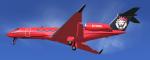

FSX/FS2004 Gulfstream G 5 N740SS
(Category: FSX > Civil Jets)
9.91Mb (12 downloads)
MSN 532 was built in 1997 and was allocated tail number N532GA for Gulfstream Aerospace. Its second owner re-registered it as N282Q in September 1998 and it stayed as that, until the fifth owner re-registered it as N282QA in December 2002. It became N740SS in May 2003 and acquired this amazing colour scheme in 2025. Painted on to the Peter Brun/Lider Designs Gulfstream G V model, this shows N740SS as seen in late 2025.
Posted Apr 3, 2026 17:30 by Steve Morley
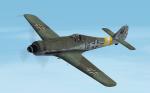
Focke Wulf Fw 190D-9 II./JG2
(Category: CFS2 > Aircraft)
11.30Mb (12 downloads)
Focke Wulf Fw 190D-9
by Design Team Daedalus
Unit: II./JG2 Frankfurt May 1945
Pilot: unknown
The Fw 190D-9 combined the Fw 190A-8 fuselage and wings with the Jumo 213A-1 engine to create a higher altitude capable fighter than the A-8. The first production aircraft were completed at Focke-Wulf’s factory at Sorau in Silesia in late August 1944. Problems with engine meant that the second aircraft wasn’t completed until mid-September, but construction soon sped up. By the end of September production was underway at Focke-Wulf’s factory at Cottbus, and in October work began at Roland (WFG) at Nordenahm and Fieseler at Kassel. Junkers and Siebel produced parts, and Arado was also involved in the program. The total number produced is unclear, with at least 670 known and no records for December 1944 or February 1945 to the end of the war. 1,500 serial numbers are known to have been allocated to the D-9, but that doesn’t mean that all of these aircraft were completed.
The standard D-9 was armed with two 13mm MG 131 machine guns above the engine and two 20mm MG 151 cannon in the wing roots. It could also carry an ETC 501 or ETC 504 stores carriers below the fuselage.
The first D-9 unit, III./JG 54, began to convert to the type in September 1944, and by the end of October had 68 aircraft, of which only one had the MW 50 installed. However 53 had been given a new Junkers kit that increased the manifold pressure in the engine and boosted power from 1,750hp to around 1,870hp.
By the end of December 1944 there were 183 D-9s in service with three units (III./JG 54, II./JG 26 and III./JG 26), with some equipped with both the MW 50 and Junkers kits, some with one or the other and some without either. However new aircraft coming off the production line mainly had both.
Early in 1945 the D-9 was issued to JG 2, JG 3, JG 6, JG 51 and JG 301, although these units normally operated a mix of types. In service the D-9 was considered to be as good as its main opponents, in particular the Merlin powered P-51 Mustangs and the Griffon powered Spitfire Mk.XIV. It handled better than the Fw 190A, was faster and climbed quicker. It could out-turn most Soviet fighters at the normal combat levels, and was quicker in the dive than the Yak-3 or Yak-9.
It was a very good fighter for that time but was too little too late to have any effect on the course of the war.
--------------------------------------------------------------------------------------------------------------------------------------------------------------------
Captain Kurt developed the model from the old Pstrany Dora model - with permission - as a starting framework and updated the shape, and added multiple details, new parts, new VC, and animations. The original Pstrany airfiles, and Dora weapons models for the drop tanks, weapons, and racks are still used as is the Jumo sound package (included)
Captain Kurt also created the camouflage paint, and the 2D instrument panel.
Posted Feb 7, 2026 22:46 by Design Team Daedalus
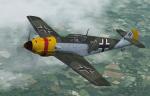
Bf109E4_8.JG53
(Category: CFS2 > Aircraft)
8.49Mb (12 downloads)
Messerschmitt Bf 109E-4
by Design Team Daedalus
Unit: 8./JG53 October 1940
Pilot: Oblt. Walter Fiel
The E-3 was replaced by the E-4 (with many airframes being upgraded to E-4 standards starting at the beginning of the Battle of Britain), which was different in some small details, most notably by using the modified 20 mm MG-FF/M wing cannon and having improved head armor for the pilot. With the MG FF/M, it was possible to fire a new and improved type of explosive shell, called Minengeschoß (or 'mine-shell'), which was made using drawn steel (the same way brass cartridges are made) instead of being cast as was the usual practice. This resulted in a shell with a thin but strong wall, which had a larger cavity in which to pack a much larger explosive charge than was otherwise possible. The new shell required modifications to the MG FF's mechanism due to the different recoil characteristics, hence the MG FF/M designation.
The cockpit canopy was also revised to an easier-to-produce, "squared-off" design, which also helped improve the pilot's field of view. This canopy, which was also retrofitted to many E-1s and E-3s, was largely unchanged until the introduction of a welded, heavy-framed canopy on the G series in the autumn of 1942. The E-4 would be the basis for all further Bf 109E developments. Some E-4 and later models received a further improved 1,175 PS (1,159 hp, 864 kW) DB601N high-altitude engine; known as the E-4/N; owing to priority being given to equipping Bf 110s with this engine, one fighter gruppe was converted to this version, starting in July 1940.[21] The E-4 was also available as a fighter-bomber with equipment very similar to the previous E-1/B. It was known as E-4/B (DB 601Aa engine) and E-4/BN (DB 601N engine). A total of 561 of all E-4 versions were built,[13] including 496 E-4s built as such: 250 E-4, 211 E-4/B, 15 E-4/N and 20 E-4/BN.
There were many small differences between individual E-4s because the E-4 was often modified in the field by groundcrew and rear area repair depots. The production standard had no pilot armor. Mods included types of pilot head armor, armored windscreen, tropical sand filters, E-7 type pointed spinners, etc.
So each model we have created has its own unique features. This aircraft was modified with a flat plate plus curved top pilot head armor and a capped nose spinner. Based on its 70/71 camouflage it was likely an E-3 upgraded to an E-4.
Pstrany is the primary model author with some small model refinement and additions by Captain Kurt as the model was collaborated on during development. Captain Kurt created the textures for each, the 2D instrument panel, the individual .dp files, air files and aircraft.cfg files.
Posted Oct 12, 2025 16:01 by Design Team Daedalus
Bf109E4_2.JG3
(Category: CFS2 > Aircraft)
7.96Mb (12 downloads)
Messerschmitt Bf 109E-4
by Design Team Daedalus
Unit: 2.JG3 Colombert, France, Oct 1940
Pilot: unknown
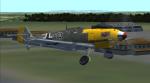
The E-3 was replaced by the E-4 (with many airframes being upgraded to E-4 standards starting at the beginning of the Battle of Britain), which was different in some small details, most notably by using the modified 20 mm MG-FF/M wing cannon and having improved head armor for the pilot. With the MG FF/M, it was possible to fire a new and improved type of explosive shell, called Minengeschoß (or 'mine-shell'), which was made using drawn steel (the same way brass cartridges are made) instead of being cast as was the usual practice. This resulted in a shell with a thin but strong wall, which had a larger cavity in which to pack a much larger explosive charge than was otherwise possible. The new shell required modifications to the MG FF's mechanism due to the different recoil characteristics, hence the MG FF/M designation.
The cockpit canopy was also revised to an easier-to-produce, "squared-off" design, which also helped improve the pilot's field of view. This canopy, which was also retrofitted to many E-1s and E-3s, was largely unchanged until the introduction of a welded, heavy-framed canopy on the G series in the autumn of 1942. The E-4 would be the basis for all further Bf 109E developments. Some E-4 and later models received a further improved 1,175 PS (1,159 hp, 864 kW) DB601N high-altitude engine; known as the E-4/N; owing to priority being given to equipping Bf 110s with this engine, one fighter gruppe was converted to this version, starting in July 1940.[21] The E-4 was also available as a fighter-bomber with equipment very similar to the previous E-1/B. It was known as E-4/B (DB 601Aa engine) and E-4/BN (DB 601N engine). A total of 561 of all E-4 versions were built,[13] including 496 E-4s built as such: 250 E-4, 211 E-4/B, 15 E-4/N and 20 E-4/BN.
There were many small differences between individual E-4s because the E-4 was often modified in the field by groundcrew and rear area repair depots. The production standard had no pilot armor. Mods included types of pilot head armor, armored windscreen, tropical sand filters, E-7 type pointed spinners, etc.
So each model we have created has its own unique features. This aircraft was modified with a capped spinner, flat plate head armor and the tail wheel opening was faired over.
Pstrany is the primary model author with some small model refinement and additions by Captain Kurt as the model was collaborated on during development. Captain Kurt created the textures for each, the 2D instrument panel, the individual .dp files, air files and aircraft.cfg files.
Posted Oct 12, 2025 15:56 by Design Team Daedalus
Bf109E3B_5.JG77
(Category: CFS2 > Aircraft)
7.97Mb (12 downloads)
Messerschmitt Bf 109E-3/B
by Design Team Daedalus
Unit: 5./JG 77 May, 1941 Malaoi, Greece
Pilot: Unknown
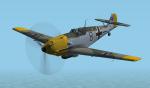
To improve the performance of the Bf 109E, the last two real prototypes (V16 and V17) were constructed. These received some structural improvements and more powerful armament. Both were the basis of the Bf 109 E-3 version. The E-3 was armed with the two MG 17s above the engine and one MG FF cannon in each wing. Some units began recieving the E-3 by September 1939. A total of 1,276 E-3 were built, including 83 E-3a export versions.
The E-3/B was a small batch of E-3s that became the first operational Bf 109 fighter bomber, or Jagdbomber (usually abbreviated to Jabo). These were fitted with an ETC 500 bomb rack, carrying one 250 kg (550 lb) bomb.
There were many small differences between indivual E-3s because the E-3 was often modified in the field by groundcrew and rear area repair depots. The production standard had no pilot armor. Mods included types of pilot head armor,E-4 type squared canopies, E-7 type pointed spinners, etc.
So each model we have created has its own unique features. This aircraft was modified with flat plate pilot head armor.
Pstrany is the primary model author with some small model refinement and additions by Captain Kurt as the model was collaborated on during development. Captain Kurt created the textures for each, the 2D instrument panel, the individual .dp files, air files and aircraft.cfg files.
Posted Oct 12, 2025 15:52 by Design Team Daedalus

Bf109E-7 7.JG26
(Category: CFS2 > Aircraft)
10.05Mb (12 downloads)
Messerschmitt Bf 109E-7
by Design Team Daedalus
Unit: 7./JG26 Gela, Sicily 1941
Pilot: Oblt. Joachim Muncheberg
Following the E-4, the E-7 was the next major production variant, entering service and seeing combat at the end of August 1940. One of the limitations of the earlier Bf 109Es was their short range of 660 km (410 mi) and limited endurance, as the design was originally conceived as a short-range interceptor. The E-7 rectified this problem as it was the first Bf 109 subtype to be able to carry a drop tank, usually the standardized Luftwaffe 300 L (79 US gal) capacity unit mounted on a centre-line rack under the fuselage, which increased its range to 1,325 km (820 mi). Fuel from the drop tank was pumped to the internal fuel tank via a large fuel line that ran up and along the inside starboard wall of the cockpit, with a clear sight glass located in the fuel line's main span so the pilot could easily see the flow of fuel and know when the tank was empty. Alternatively, a bomb could be fitted and the E-7 could be used as a Jabo fighter-bomber. Previous Emil subtypes were progressively retrofitted with the necessary fittings for carrying a drop tank from October 1940. Early E-7s were fitted with the 1,100 PS DB 601A or 1,175 PS DB 601Aa engine, while late-production ones received 1,175 PS DB 601N engines with improved altitude performance the latter was designated as E-7/N. A total of 438 E-7s of all variants were built.
There were many small differences between individual E-7s because the E-7 was often modified in the field by groundcrew and rear area repair depots. The production standard had no pilot armor. Mods included types of pilot head armor, armored windscreen, tropical sand filters, etc.
So each model we have created has its own unique features. This aircraft was modified with flat plate pilot head armor and had a command pennant atached to the antenna mast.
Pstrany is the primary model author with some small model refinement and additions by Captain Kurt as the model was collaborated on during development. Captain Kurt created the textures for each, the 2D instrument panel, the individual .dp files, air files and aircraft.cfg files.
Posted Oct 12, 2025 15:34 by Design Team Daedalus
Bf109E-7 3.JG1
(Category: CFS2 > Aircraft)
9.20Mb (12 downloads)
Messerschmitt Bf 109E-7
by Design Team Daedalus
Unit: 3./JG1 De Kooy, Holland 1941
Pilot: Hans Schubert (rank unknown)
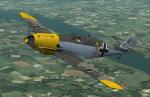
Following the E-4, the E-7 was the next major production variant, entering service and seeing combat at the end of August 1940. One of the limitations of the earlier Bf 109Es was their short range of 660 km (410 mi) and limited endurance, as the design was originally conceived as a short-range interceptor. The E-7 rectified this problem as it was the first Bf 109 subtype to be able to carry a drop tank, usually the standardized Luftwaffe 300 L (79 US gal) capacity unit mounted on a centre-line rack under the fuselage, which increased its range to 1,325 km (820 mi). Fuel from the drop tank was pumped to the internal fuel tank via a large fuel line that ran up and along the inside starboard wall of the cockpit, with a clear sight glass located in the fuel line's main span so the pilot could easily see the flow of fuel and know when the tank was empty. Alternatively, a bomb could be fitted and the E-7 could be used as a Jabo fighter-bomber. Previous Emil subtypes were progressively retrofitted with the necessary fittings for carrying a drop tank from October 1940. Early E-7s were fitted with the 1,100 PS DB 601A or 1,175 PS DB 601Aa engine, while late-production ones received 1,175 PS DB 601N engines with improved altitude performance the latter was designated as E-7/N. A total of 438 E-7s of all variants were built.
There were many small differences between individual E-7s because the E-7 was often modified in the field by groundcrew and rear area repair depots. The production standard had no pilot armor. Mods included types of pilot head armor, armored windscreen, tropical sand filters, etc.
So each model we have created has its own unique features. This aircraft was unmodified and had no pilot head armor.
Pstrany is the primary model author with some small model refinement and additions by Captain Kurt as the model was collaborated on during development. Captain Kurt created the textures for each, the 2D instrument panel, the individual .dp files, air files and aircraft.cfg files.
Posted Oct 12, 2025 15:32 by Design Team Daedalus
Bf109F-2_9.JG2
(Category: CFS2 > Aircraft)
18.24Mb (12 downloads)
Messerschmitt Bf109F-2
by Design Team Daedalus
Unit: 9./JG2 France May, 1942
Pilot: Oblt Siegfried Schnell
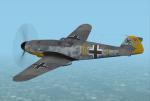
There is no "standard" Bf 109F-2, as the production run underwent many small modifications and there were field implemented updates along the way. So each model we have created has it's own unique features.
Pstrany developed the models using Paul Rebuffat's Messerschmitt model - with permission - as a starting framework and updated the shape, and added a plethora of details, new parts, and ideas. Pstrany also developed the models for the drop tanks, weapons and racks.
Captain Kurt created paints for each, the 2D instrument panel, the individual .dp files, the air files and the aircraft.cfg files.
Mav SCASM edited each model so that they have animated wing slats, drop tanks, and other features, as well as optimizing models for the best possible framerates. Mav also developed the idea for the 2d panel to be offset for the Revi gunsight to match the CFS2 reticle.
The engine sound package is by Lawdog2360
Posted Oct 8, 2025 23:09 by Design Team Daedalus
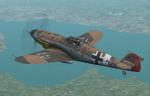
Bf109G-2_Trop_8JG27
(Category: CFS2 > Aircraft)
12.64Mb (12 downloads)
Messerschmitt Bf109G-2/Trop
by Design Team Daedalus
Unit: 8./JG27 Rhodes, Greece February 1943
Pilot: Oblt. Werner Schroer
During the summer of 1941, the Messerschmitt design team was engaged in updating the BF 109F-4 as the dictates of the air war was forcing the need for greater speeds. The result was the Gustav series, of which the first substantial production run was the Bf 109G-2. Adopting the more powerful but heavier Mercedes Benz DB 605 engine required airframe and landing gear strengthening which also added weight. But it was felt the increase in speed made the loss of some maneuverability acceptable. The fuel filler access was moved to the spine behind the cockpit. No change was required for the cowling shape but a deeper oil cooler was needed. The broad blade of the F4/Z was made standard. The lower quarter cockpit window panel was deleted and vent scoops could be added to the new replacement metal panel. The wheel wells reverted to a squared end in anticipation of wheel covers that in the event were not adopted. Generally speaking the appearance of the G-2 was very similar to the F-4 without close examination. Deliveries of the G-2 began in May 1942 with 1,587 produced by February 1943.
The Tropical version had a sand filter for the supercharger, umbrella attachment points under the canopy on the port side, sand proofing rubber seals around hydraulic cylinders (not visible) and survival gear and a Kar98 rifle stowed in the aft fuselage (also not visible).
However, there is no "standard" Bf 109G-2. Although production only ran 10 months before the G-3 and G-4 were introduced, three separate companies and multiple sub-assembly production facilities were involved which inevitably produced minor variations, such as pilot head armor type, cockpit vents and tail wheel types. So each model we have created has its own unique features to portray the specific aircraft presented as accurately as possible.
Besides the sand filter, this aircraft had the port side umbrella attachment fixtures removed, a cockpit vent both sides, a flat plate pilot armor and a fixed tail wheel with the wheel bay faired over.
Pstrany developed the models using Paul Rebuffat's Messerschmitt model - with permission - as a starting framework and updated the shape, and added a plethora of details, new parts, and ideas. Pstrany also developed the models for the drop tanks, weapons and racks.
Captain Kurt created paints for each, the 2D instrument panel, the individual .dp files, the air files and the aircraft.cfg files.
Mav SCASM edited each model so that they have animated wing slats, drop tanks, and other features, as well as optimizing models for the best possible framerates. Mav also developed the idea for the 2d panel to be offset for the Revi gunsight to match the CFS2 reticle.
Posted Oct 4, 2025 21:16 by Design Team Daedalus